Advertisements
Advertisements
प्रश्न
State Kirchhoff’s current rule.
Advertisements
उत्तर
- Kirchhoff’s current rule states that the algebraic sum of the currents at any junction of a circuit is zero.
i.e `Σ_"junction"` i = 0 - It is a statement of conservation of electric charge.
APPEARS IN
संबंधित प्रश्न
Consider the following two statements:-
(A) Kirchhoff's junction law follows from conservation of charge.
(B) Kirchhoff's loop law follows from conservative nature of electric field.
Consider the potentiometer circuit as arranged in the figure. The potentiometer wire is 600 cm long. (a) At what distance from the point A should the jockey touch the wire to get zero deflection in the galvanometer? (b) If the jockey touches the wire at a distance of 560 cm from A, what will be the current in the galvanometer?
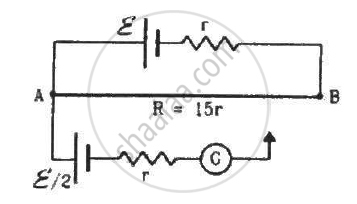
On which conservation principle is Kirchoff's Second Law of electrical networks based?
State the principle of potentiometer.
What does Kirchhoff's Voltage Law state for a closed loop?
After a charge completes one full loop and returns to its starting point, what is the net change in potential?
In a closed loop containing cells and resistors, what equals the total potential drop across the resistors?
What is the sign of the emf when moving from the negative terminal to the positive terminal of a cell?
At junction P, currents \[0.2\,\mathrm{A}\], \[0.6\,\mathrm{A}\], and \[0.7\,\mathrm{A}\] point towards P, while \[0.4\,\mathrm{A}\], \[0.5\,\mathrm{A}\], and \[I\] point away. What is the unknown current?
How are Kirchhoff's laws used in analysing a general network with several unknown branch currents?
