Advertisements
Advertisements
प्रश्न
In the circuit shown in Figure below, E1 and E2 are batteries having emfs of 25V and 26V. They have an internal resistance of 1 Ω and 5 Ω respectively. Applying Kirchhoff’s laws of electrical networks, calculate the currents I1 and I2.

Advertisements
उत्तर
Applying Kirchhoff's voltage law to loop ABCDEF, we get
2(I1 + I2) + 3I2 - 26 + 5I2 = 0
or 2I1 + 2I2 + 3I2 + 5I2 = 26
or I1 + 5I2 = 13 ...(i)
Now, applying Kirchhoff’s voltage law to loop HJBCDEG.
2(I1 + I2) + 4I1 + I1 - 25 = 0
or 2I1 + 2I2 + 5I1 = 25
or 7I1 + 2I2 = 25 ...(ii)
Equation (i) × 2 - equation (ii) × 5
2I1 + 10I2 = 26
35I1 + 10I2 = 125
- - -
- 33I1 = - 99
I1 = 3
From equation (i)
3 + 5I2 = 13
or I2 = 2
Hence I1 = 3 A
I2 = 2 A.
APPEARS IN
संबंधित प्रश्न
State the two Kirchhoff’s rules used in electric networks. How are there rules justified?
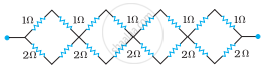
Determine the equivalent resistance of networks shown in Fig.
How the emf of two cells are compared using potentiometer?
A copper wire of 10-6 m2 area of cross-section, carries a current of 2 A. If the number of electrons per cubic meter is 8 × 1028, calculate the current density and average drift velocity.
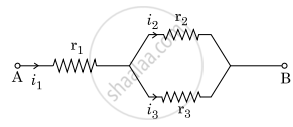
Three resistors having resistances r1, r2 and r3 are connected as shown in the given circuit. The ratio `"i"_3/"i"_1` of currents in terms of resistances used in the circuit is :
Which two basic physical principles form the basis of Kirchhoff's laws?
What is Kirchhoff's Voltage Law also called?
What does Kirchhoff's Voltage Law state for a closed loop?
What is potential difference?
Why must the amount of charge entering a junction per second equal the amount leaving when current is steady?
