Advertisements
Advertisements
प्रश्न
Using Ampere’s circuital law, obtain an expression for magnetic flux density ‘B’ at a point near an infinitely long and straight conductor, carrying a current I.
Advertisements
उत्तर
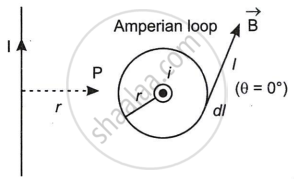
Consider a point P at a distance from a straight infinity long wire (conductor) carrying a current I in free space.
Because of the axial symmetry about the straight wire, the magnetic induction has the same magnitude B at all points on a circle in a transverse plane and centred on the wire. We therefore choose an Amperian loop, a circle of radius r centred on the wire with its plane perpendicular to the wire.
`vec"B"` is everywhere tangential to the circular Amperian loop.
Angle θ = 0° (between `vec"B" and vec"dl"`) at all points on the loop.
`oint vec"B" * vec"dl" = oint "Bdl" = "B" oint "dl" = "B"(2pi"r")`
`therefore oint vec"B" * vec"dl" = mu_0"I"`
Where `mu_0` is the permeability of free space.
B = `(mu_0 "I")/(2pi"r")`
APPEARS IN
संबंधित प्रश्न
State Ampere’s circuital law.
State Ampere’s circuital law.
Electron drift speed is estimated to be of the order of mm s−1. Yet large current of the order of few amperes can be set up in the wire. Explain briefly.
A hollow tube is carrying an electric current along its length distributed uniformly over its surface. The magnetic field
(a) increases linearly from the axis to the surface
(b) is constant inside the tube
(c) is zero at the axis
(d) is zero just outside the tube.
A long, cylindrical wire of radius b carries a current i distributed uniformly over its cross section. Find the magnitude of the magnetic field at a point inside the wire at a distance a from the axis.
A thick current carrying cable of radius ‘R’ carries current ‘I’ uniformly distributed across its cross-section. The variation of magnetic field B(r) due to the cable with the distance ‘r’ from the axis of the cable is represented by ______
Briefly explain various ways to increase the strength of the magnetic field produced by a given solenoid.
Magnetic fields are produced by:
Which law provides a simpler alternative method for finding the magnetic field \[B\] when the current distribution has symmetry (straight wire, solenoid, toroid)?
