Advertisements
Advertisements
Question
Using Ampere’s circuital law, obtain an expression for magnetic flux density ‘B’ at a point near an infinitely long and straight conductor, carrying a current I.
Advertisements
Solution
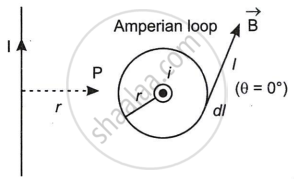
Consider a point P at a distance from a straight infinity long wire (conductor) carrying a current I in free space.
Because of the axial symmetry about the straight wire, the magnetic induction has the same magnitude B at all points on a circle in a transverse plane and centred on the wire. We therefore choose an Amperian loop, a circle of radius r centred on the wire with its plane perpendicular to the wire.
`vec"B"` is everywhere tangential to the circular Amperian loop.
Angle θ = 0° (between `vec"B" and vec"dl"`) at all points on the loop.
`oint vec"B" * vec"dl" = oint "Bdl" = "B" oint "dl" = "B"(2pi"r")`
`therefore oint vec"B" * vec"dl" = mu_0"I"`
Where `mu_0` is the permeability of free space.
B = `(mu_0 "I")/(2pi"r")`
APPEARS IN
RELATED QUESTIONS
Explain Ampere’s circuital law.
Consider the situation described in the previous problem. Suppose the current i enters the loop at the points A and leaves it at the point B. Find the magnetic field at the centre of the loop.
Consider the situation of the previous problem. A particle having charge q and mass mis projected from the point Q in a direction going into the plane of the diagram. It is found to describe a circle of radius r between the two plates. Find the speed of the charged particle.
Find the magnetic field due to a long straight conductor using Ampere’s circuital law.
Two identical current carrying coaxial loops, carry current I in opposite sense. A simple amperian loop passes through both of them once. Calling the loop as C, then which statement is correct?
The force required to double the length of a steel wire of area 1 cm2, if it's Young's modulus Y = `2 xx 10^11/m^2` is:
A thick current carrying cable of radius ‘R’ carries current ‘I’ uniformly distributed across its cross-section. The variation of magnetic field B(r) due to the cable with the distance ‘r’ from the axis of the cable is represented by ______
A long straight wire of radius 'a' carries a steady current 'I'. The current is uniformly distributed across its area of cross-section. The ratio of the magnitude of magnetic field `vecB_1` at `a/2` and `vecB_2` at distance 2a is ______.
Magnetic fields are produced by:
Substituting \[B=\frac{\mu_0 I}{2\pi r}\] into \[\oint\vec{B}\cdot d\vec{l}=B(2\pi r)\] for a straight wire yields:
