Advertisements
Advertisements
Questions
Using Huygen’s wave theory of light, show that the angle of incidence is equal to the angle of reflection. Draw a neat and labelled diagram.
Using Huygen’s wave theory and a labelled diagram, show that angle of reflection (r) is equal to angle of incidence (i).
Advertisements
Solution
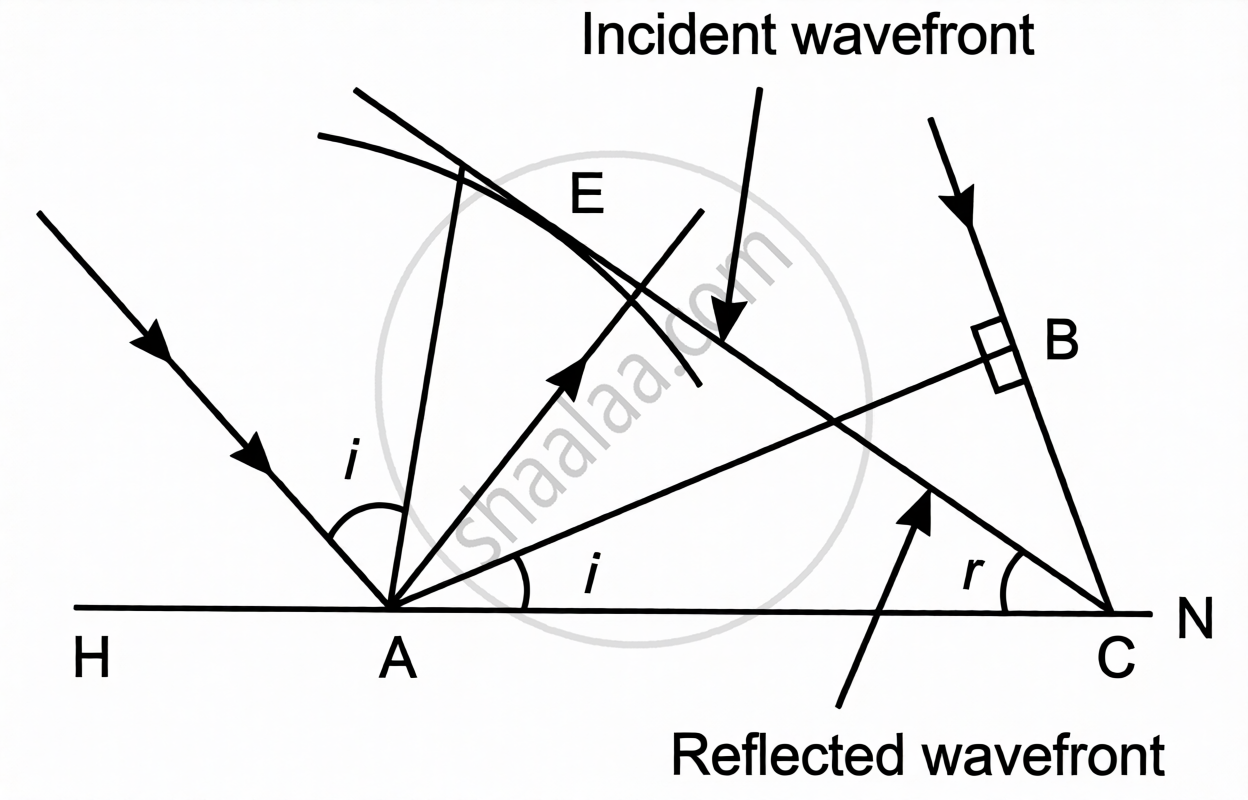
Consider a plane wave AB incident at an angle i on a reflecting surface MN. If v represents the speed of the wave in the medium and if T represents the time taken by the wavefront to advance from point B to C, then distance BC = vt.
In order to construct the reflected wavefront, a sphere of radius = vt is drawn from point A, as shown in the figure. Let CE represent the tangent plane drawn from the point C to this surface.
∴ AE = BC = vt
∠ABC = ∠CEA = 90°
Here, AC is common.
∴ ΔEAC ≅ ΔBAC
Hence i = r
RELATED QUESTIONS
Using Huygens's construction of secondary wavelets explain how a diffraction pattern is obtained on a screen due to a narrow slit on which a monochromatic beam of light is incident normally.
The refractive indices of water and diamond are `4/3` and 2.42 respectively. Find the speed of light in water and diamond. (c = 3x10⁸ m/s)
State Huygens’s principle. Show, with the help of a suitable diagram, how this principle is used to obtain the diffraction pattern by a single slit.
Draw a plot of intensity distribution and explain clearly why the secondary maxima becomes weaker with increasing order (n) of the secondary maxima.
Derive the law of reflection using Huygen’s Wave Theory.
For light diverging from a point source ______.
- the wavefront is spherical.
- the intensity decreases in proportion to the distance squared.
- the wavefront is parabolic.
- the intensity at the wavefront does not depend on the distance.
Two light beams of intensities in the ratio of 9 : 4 are allowed to interfere. The ratio of the intensity of maxima and minima ______.
According to Huygens’s principle, the amplitude of secondary wavelets is ______.
What type of wavefronts are associated with a source infinity?
What is a wavefront?
What did Huygens explain by assuming zero amplitude of secondary wavelets in the backward direction?
