Advertisements
Advertisements
प्रश्न
Using Huygen’s wave theory of light, show that the angle of incidence is equal to the angle of reflection. Draw a neat and labelled diagram.
Using Huygen’s wave theory and a labelled diagram, show that angle of reflection (r) is equal to angle of incidence (i).
Advertisements
उत्तर
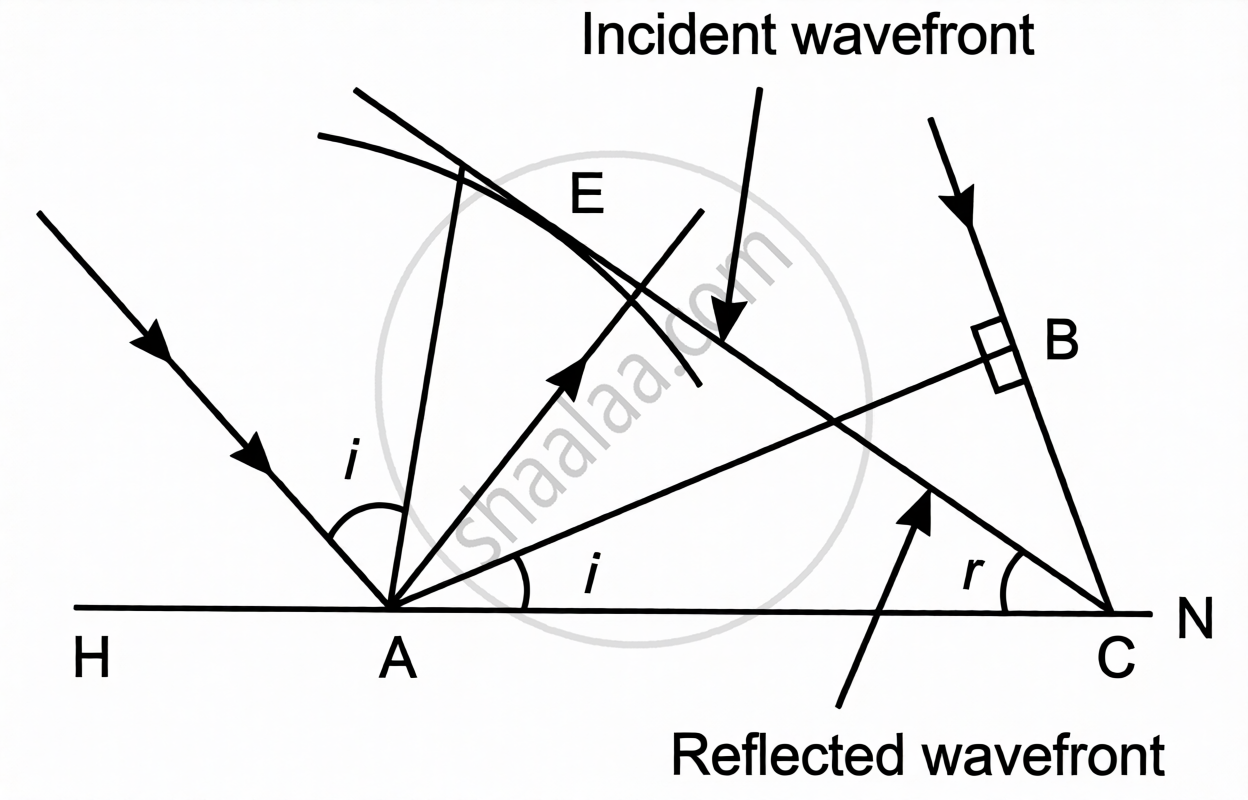
Consider a plane wave AB incident at an angle i on a reflecting surface MN. If v represents the speed of the wave in the medium and if T represents the time taken by the wavefront to advance from point B to C, then distance BC = vt.
In order to construct the reflected wavefront, a sphere of radius = vt is drawn from point A, as shown in the figure. Let CE represent the tangent plane drawn from the point C to this surface.
∴ AE = BC = vt
∠ABC = ∠CEA = 90°
Here, AC is common.
∴ ΔEAC ≅ ΔBAC
Hence i = r
संबंधित प्रश्न
Using Huygens's construction of secondary wavelets explain how a diffraction pattern is obtained on a screen due to a narrow slit on which a monochromatic beam of light is incident normally.
What is the shape of the wavefront in the following case?
Light emerging out of a convex lens when a point source is placed at its focus.
State Huygen’s principle.
When the width of the slit is made double the original width, how would this affect the size and intensity of the central diffraction band?
Huygen's conception of secondary waves ______.
According to Huygens’s principle, the amplitude of secondary wavelets is ______.
What is a wavefront?
When can a small portion of a spherical wave be considered as a plane?
At any instant, where is the disturbance maximum on the surface of the water?
What are the wavelets emanating from points on a wavefront called?
