Advertisements
Advertisements
प्रश्न
Light waves travel in vacuum along the X-axis. Which of the following may represent the wave fronts?
विकल्प
x = c
y = c
z = c
x + y + z = c
Advertisements
उत्तर
x = c
The wave is travelling along the X-axis. So, it'll have planar wavefront perpendicular to the X-axis.
APPEARS IN
संबंधित प्रश्न
Use Huygens' principle to verify the laws of refraction.
The refractive indices of water and diamond are `4/3` and 2.42 respectively. Find the speed of light in water and diamond. (c = 3x10⁸ m/s)
Use Huygens’s principle to explain the formation of diffraction pattern due to a single slit illuminated by a monochromatic source of light.
Huygens' principle of secondary wavelets may be used to
(a) find the velocity of light in vacuum
(b) explain the particle behaviour of light
(c) find the new position of a wavefront
(d) explain Snell's Law
Derive the law of reflection using Huygen’s Wave Theory.
Answer the following question.
Define the term wavefront. Using Huygen's wave theory, verify the law of reflection.
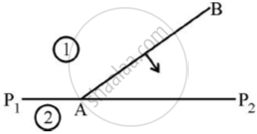
A plane wave front AB propagating from denser medium (1) into a rarer medium (2) is incident on the surface P1P2 separating the two media as shown in fig.
Using Huygen’s principle, draw the secondary wavelets and obtain the refracted wave front in the diagram.
According to Huygens principle, ______.
According to Huygen's construction, relation between old and new wavefront is ______.
For light diverging from a point source ______.
- the wavefront is spherical.
- the intensity decreases in proportion to the distance squared.
- the wavefront is parabolic.
- the intensity at the wavefront does not depend on the distance.
Two light beams of intensities in the ratio of 9 : 4 are allowed to interfere. The ratio of the intensity of maxima and minima ______.
What type of wavefronts are associated with a point source of light?
At any instant, where is the disturbance maximum on the surface of the water?
What is meant by the speed of the wave?
In what direction does the energy of a wave travel relative to its wavefront?
In Huygens' principle, what does each point of the wavefront act as?
What role does each point of a spherical wavefront play in constructing its later position?
For what other type of wavefront can Huygens' principle determine the shape during propagation through a medium?
