Advertisements
Advertisements
प्रश्न
Use Huygens' principle to verify the laws of refraction.
Advertisements
उत्तर
Huygens' Principle to Verify the Laws of Refraction :
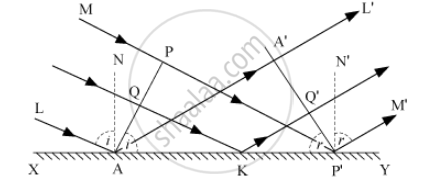
Consider any point Q on the incident wavefront PA.
When the disturbance from P on incident wavefront reaches point P', the disturbance from point Q reaches Q'.
If c is velocity of light, then time taken by light to go from point Q to Q'(via point K) is given by,
`t=(QK)/c+(KQ')/c`....(i)
In right-angled ΔAQK,
∠QAK = i
∴ QK = AK sin i
In right-angled ΔKQ'P'
∠Q'P'K=r
∴ KQ'=KP'sin r
Substituting these values in equation (i),
`t=(AKsini)/c+(KP'sinr)/c`
`t=(AKsini+KP'sinr)/c`
`t=(AKsini+(AP'-AK)sinr)/c` [∵ KP'=AP'-AK]
`t=(AP'sinr+AK(sini-sinr))/c` .....(ii)
The rays from different points on incident wavefront will take the same time to reach the corresponding points on the reflected wavefront, if ‘t’ given by equation (ii) is independent of AK.
∴ AK (sin i − sin r) = 0
sin i − sin r = 0
sin i = sin r
i = r
i.e., the angle of incidence is equal to the angle of reflection.
Also, the incident ray (LA or MP'), reflected ray (AA'L' or P'M'), and the normal (AN) − all lie in the same plane.
संबंधित प्रश्न
Explain the construction of plane wavefront using Huygens’ principle.
The refractive indices of water and diamond are `4/3` and 2.42 respectively. Find the speed of light in water and diamond. (c = 3x10⁸ m/s)
When the width of the slit is made double the original width, how would this affect the size and intensity of the central diffraction band?
According to Huygen's construction, relation between old and new wavefront is ______.
For light diverging from a point source ______.
- the wavefront is spherical.
- the intensity decreases in proportion to the distance squared.
- the wavefront is parabolic.
- the intensity at the wavefront does not depend on the distance.
Is Huygen’s principle valid for longitudinal sound waves?
Represent diagrammatically how the incident planar wavefronts of wavelength λ pass through an aperture of size d, when d is approximately equal to λ.
In what direction does the energy of a wave travel relative to its wavefront?
What are the wavelets emanating from points on a wavefront called?
How is Huygens' adhoc assumption about the backwave assessed?
