Advertisements
Advertisements
प्रश्न
Define a wavefront. Using 'Huygens' principle, draw the shape of a refracted wavefront, when a plane wave is incident on a convex lens.
Advertisements
उत्तर
The locus of points, which oscillate in phase is called a wavefront; thus a wavefront is defined as a surface of constant phase.
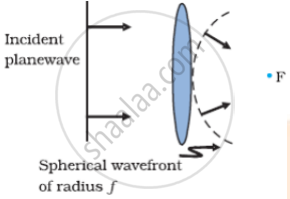
In the given figure we consider a plane wave incident on a thin convex lens, the emerging wavefront is spherical and converges to point F which is known as the focus.
APPEARS IN
संबंधित प्रश्न
On the basis of Huygens' wave theory of light prove that velocity of light in a rarer medium is greater than velocity of light in a denser medium.
Define the term wavefront. Using Huygen’s wave theory, verify the law of reflection.
What is the shape of the wavefront on earth for sunlight?
Two light beams of intensities in the ratio of 9 : 4 are allowed to interfere. The ratio of the intensity of maxima and minima ______.
How is a wavefront different from a ray?
What type of wavefronts are associated with a source infinity?
What improved devices did Christiaan Huygens design?
In what direction does the energy of a wave travel relative to its wavefront?
What did Huygens explain by assuming zero amplitude of secondary wavelets in the backward direction?
For what other type of wavefront can Huygens' principle determine the shape during propagation through a medium?
