Advertisements
Advertisements
प्रश्न
On the basis of Huygens' wave theory of light prove that velocity of light in a rarer medium is greater than velocity of light in a denser medium.
Advertisements
उत्तर
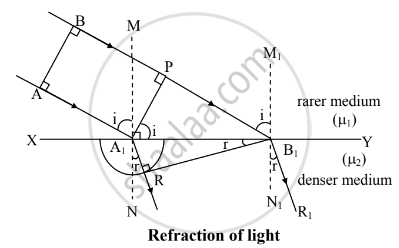
XY : plane refracting surface
AB : incident plane wavefront
B1R : refracted wavefront
AA1 , BB1 : incident rays
A1R , B1R1 : refracted rays
∠ AA1M = ∠ BB1M1 = ∠ i : angle of incidence
∠ RA1N = ∠ R1B1N1 = ∠ r : angle of refraction
- Let XY be the plane refracting surface separating two media rarer and denser of refractive indices μ1 and μ2 respectively.
- A plane wavefront AB is advancing obliquely towards XY from rarer medium. It is bounded by rays AA1 and BB1 which are incident rays.
- When 'A' reaches at 'A1' then 'B' will be at 'P' . It still has to cover distance PB1 to reach XY.
- According to Huygens' principle , secondary wavelets will originate from A1 and it will spread over a hemisphere in denser medium.
- All the rays between AA1 and BB1 will reach XY and spread over the hemispheres of increasing radii in denser medium. The surface of tangency of all such hemisphere is RB1 . This gives rise to refracted wavefront B1R in denser medium.
- A1R and B1R are refracted rays.
- Let c1 and c2 be the velocities of light in rarer and denser medium respectively.
- At any instant of time 't' , distance covered by incident wavelength from P to B1 = PB1 = c1t
Distance covered by secondary wave from A1 to R = A1R =c2t . - From above figure ,
∠ AA1M + ∠ MA1P = 90° .....(i) and
∠ MA1P + ∠ PA1B1 = 90° ...........(ii)
From equation (i) and (ii) , we have,
∠ AA1M = ∠ PA1B1 = 90° - Similarly ,
∠NA1R = ∠ N1B1R1 = r
We have,
∠ N1B1R1 + ∠ A1B1R = 90° .........(iii)
and
∠ N1B1R1 + ∠ A1B1R = 90° .........(iv)
From equations (iii) and (iv) , we have,
∠ N1B1R1 + ∠ A1B1R = r - In Δ A1PB1 ,
sin i = `"PB"_1/("A"_1"B"_1) = ("c"_1"t")/("A"_1"B"_1)` ........(v) - In Δ A1RB1 ,
sin r = `("A"_1"R")/("A"_1"B"_1) = ("c"_2"t")/("A"_1"B"_1)` ............(vi) - Dividing equation (v) bt (vi), we have
`("sin" "i")/("sin""r") = ((c_1t) / (A_1B_1))/((c_2t)/(A_1B_1))`
`therefore ("sin" "i")/("sin""r") = c_1/c_2` .....(vii)
Also `c_1/c_2 = mu_2/mu_1 = 1 mu_2` .....(viii)
where 1μ2 = R.I. of denser medium w.r.t rarer medium. - From above figure ,
∠ i > ∠ r
∴ sin i > sin r
∴ `("sin" "i")/("sin" "r") > 1`
`therefore mu_2/mu_1 > 1` .........(ix)
Since , `c_1/c_2 = mu_2/mu_1` ..........[From ix]
`therefore c_1/c_2 > 1`
`therefore c_1 > c_2`
Hence , velocity of light in rarer medium is greater than veocity in denser medium.
APPEARS IN
संबंधित प्रश्न
Explain the construction of plane wavefront using Huygens’ principle.
What is the shape of the wavefront in the following case?
Light diverging from a point source.
What is the shape of the wavefront in the following case?
Light emerging out of a convex lens when a point source is placed at its focus.
What is the shape of the wavefront in the following case?
The portion of the wavefront of light from a distant star was intercepted by the Earth.
State Huygen’s principle.
Consider a plane wave front incident on a thin convex lens. Draw a proper diagram to show how the incident wave front traverses through the lens and after refraction focusses on the focal point of the lens, giving the shape of the emergent wave front.
Use Huygens' principle to verify the laws of refraction.
Using Huygens’ principle, verify the laws of reflection at a plane surface.
Using this principle draw a diagram to show how a plane wave front incident at the interface of the two media gets refracted when it propagates from a rarer to a denser medium. Hence verify Snell's law of refraction.
State Huygens’s principle. Show, with the help of a suitable diagram, how this principle is used to obtain the diffraction pattern by a single slit.
Draw a plot of intensity distribution and explain clearly why the secondary maxima becomes weaker with increasing order (n) of the secondary maxima.
Huygens' principle of secondary wavelets may be used to
(a) find the velocity of light in vacuum
(b) explain the particle behaviour of light
(c) find the new position of a wavefront
(d) explain Snell's Law
Light waves travel in vacuum along the X-axis. Which of the following may represent the wave fronts?
Derive the law of reflection using Huygen’s Wave Theory.
Define the term wavefront. Using Huygen’s wave theory, verify the law of reflection.
Answer the following question.
Define the term wavefront. Using Huygen's wave theory, verify the law of reflection.
Define a wavefront. Using 'Huygens' principle, draw the shape of a refracted wavefront, when a plane wave is incident on a convex lens.
According to Huygen's construction, relation between old and new wavefront is ______.
What is the geometrical shape of the wavefront for:
- Light diverging from a point source?
- The pattern of wavefront of the light from a distant star intercepted by earth?
Answer the following question briefly and to the point:
What is the phase difference between any two points lying on the same wavefront?
Wavefront means
Figure shows a standard two slit arrangement with slits S1, S2, P1, P2 are the two minima points on either side of P (Figure). At P2 on the screen, there is a hole and behind P2 is a second 2-slit arrangement with slits S3, S4 and a second screen behind them.

For light diverging from a point source ______.
- the wavefront is spherical.
- the intensity decreases in proportion to the distance squared.
- the wavefront is parabolic.
- the intensity at the wavefront does not depend on the distance.
Is Huygen’s principle valid for longitudinal sound waves?
What is the shape of the wavefront on earth for sunlight?
What type of wavefronts are associated with a point source of light?
Represent diagrammatically how the incident planar wavefronts of wavelength λ pass through an aperture of size d, when d is approximately equal to λ.
Represent diagrammatically how the incident planar wavefronts of wavelength λ pass through an aperture of size d, when d is approximately equal to λ.
When can a small portion of a spherical wave be considered as a plane?
What did Christiaan Huygens explain in addition to reflection and refraction?
Which types of motion was Christiaan Huygens the first to analyse?
What improved devices did Christiaan Huygens design?
What did Christiaan Huygens discover about Saturn?
What happens when a small stone is dropped on a calm pool of water?
At any instant, where is the disturbance maximum on the surface of the water?
What is a locus of points which oscillate in phase called?
What is meant by the speed of the wave?
In what direction does the energy of a wave travel relative to its wavefront?
What kind of construction is Huygens' principle essentially?
Given the shape of a wavefront at any time, what does Huygens' principle allow to be determined?
How do wavelets emanating from points on a wavefront spread?
What are the wavelets emanating from points on a wavefront called?
What gives the new position of a wavefront at a later time in Huygens' construction?
What role does each point of a spherical wavefront play in constructing its later position?
What really justifies the absence of the backwave?
