Advertisements
Advertisements
प्रश्न
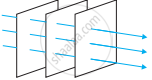
What is the shape of the wavefront in the following case?
The portion of the wavefront of light from a distant star was intercepted by the Earth.
Advertisements
उत्तर
The portion of the wavefront of the light from a distant star intercepted by the Earth is a plane.
संबंधित प्रश्न
Using Huygens's construction of secondary wavelets explain how a diffraction pattern is obtained on a screen due to a narrow slit on which a monochromatic beam of light is incident normally.
What is the shape of the wavefront in the following case?
Light diverging from a point source.
What is the shape of the wavefront in the following case?
Light emerging out of a convex lens when a point source is placed at its focus.
State Huygen’s principle.
Consider a plane wave front incident on a thin convex lens. Draw a proper diagram to show how the incident wave front traverses through the lens and after refraction focusses on the focal point of the lens, giving the shape of the emergent wave front.
Using this principle draw a diagram to show how a plane wave front incident at the interface of the two media gets refracted when it propagates from a rarer to a denser medium. Hence verify Snell's law of refraction.
Two light beams of intensities in the ratio of 9 : 4 are allowed to interfere. The ratio of the intensity of maxima and minima ______.
According to Huygens’s principle, the amplitude of secondary wavelets is ______.
Which book by Christiaan Huygens is cited as an important work?
What happens when a small stone is dropped on a calm pool of water?
How does every point on the surface of a calm pool respond after a small stone is dropped into it?
At any instant, where is the disturbance maximum on the surface of the water?
What is a locus of points which oscillate in phase called?
In what direction does the energy of a wave travel relative to its wavefront?
Given the shape of a wavefront at any time, what does Huygens' principle allow to be determined?
How do wavelets emanating from points on a wavefront spread?
What are the wavelets emanating from points on a wavefront called?
What did Huygens explain by assuming zero amplitude of secondary wavelets in the backward direction?
