Advertisements
Advertisements
प्रश्न
Using this principle draw a diagram to show how a plane wave front incident at the interface of the two media gets refracted when it propagates from a rarer to a denser medium. Hence verify Snell's law of refraction.
Advertisements
उत्तर
Huygens’ Principle:
• Each point on the primary wave front acts as a source of secondary wavelets, sending out disturbance in all directions in a similar manner as the original source of light does.
• The new position of the wave front at any instant (called secondary wave front) is the envelope of the secondary wavelets at that instant.
Refraction On The Basis Of Wave Theory
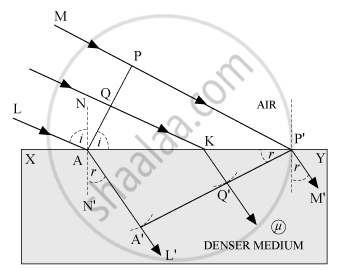
• Consider any point Q on the incident wave front.
• Suppose when disturbance from point P on incident wave front reaches point P'on the refracted wave front, the disturbance from point Q reaches Q' on the refracting surface XY.
• Since P'A'epresents the refracted wave front, the time taken by light to travel from a point on incident wave front to the corresponding point on refracted wave front should always be the same. Now, time taken by light to go from Q to Q' will be `t = (QK)/c + (KQ)/v ...(1)`
In right-angled ΔAQK, ∠QAK = i
∴ QK = AK sin i … (2)
In right-angled ΔP'Q'K, ∠Q'P'K, = r and KQ = KP sin r…. (3)
Substituting (2) and (3) in equation (1),
`t = (AK sin i)/c + (KP'sin r)/v`
or, `(AK sin i)/c + ((AP' - AK)sin r)/v` (∵ KP' = AP' -AK)
or,`t = (AP')/c sinr + AK ((sin i )/c - (sin r)/v) ...... (4)`
The rays from different points on the incident wave front will take the same time to reach the corresponding points on the refracted wave front i.e., t given by equation (iv) is independent of AK. It will happen so, if`(sin i)/c -(sin r)/v =0 ⇒ (sini)/(sinr) =c/v ⇒μ = (sini)/(sinr) `
This is the Snell’s law for refraction of light.
APPEARS IN
संबंधित प्रश्न
Use Huygens’s principle to explain the formation of diffraction pattern due to a single slit illuminated by a monochromatic source of light.
Light waves travel in vacuum along the X-axis. Which of the following may represent the wave fronts?
What is the shape of the wavefront on earth for sunlight?
Using Huygen’s wave theory of light, show that the angle of incidence is equal to the angle of reflection. Draw a neat and labelled diagram.
Represent diagrammatically how the incident planar wavefronts of wavelength λ pass through an aperture of size d, when d is approximately equal to λ.
What is a wavefront?
When can a small portion of a spherical wave be considered as a plane?
What did Christiaan Huygens explain in addition to reflection and refraction?
Which types of motion was Christiaan Huygens the first to analyse?
What are the wavelets emanating from points on a wavefront called?
