Advertisements
Advertisements
प्रश्न
How is a wavefront different from a ray?
Advertisements
उत्तर
- The ray indicates the direction of propagation of the wave while the wavefront is the surface of the constant phase.
- The ray at each point of a wavefront is normal to the wavefront at that point.
APPEARS IN
संबंधित प्रश्न
Explain the construction of plane wavefront using Huygens’ principle.
What is the shape of the wavefront in the following case?
Light emerging out of a convex lens when a point source is placed at its focus.
State Huygen’s principle.
Using Huygens’ principle, verify the laws of reflection at a plane surface.
Define a wavefront. Using 'Huygens' principle, draw the shape of a refracted wavefront, when a plane wave is incident on a convex lens.
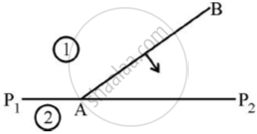
A plane wave front AB propagating from denser medium (1) into a rarer medium (2) is incident on the surface P1P2 separating the two media as shown in fig.
Using Huygen’s principle, draw the secondary wavelets and obtain the refracted wave front in the diagram.
What did Christiaan Huygens explain in addition to reflection and refraction?
At any instant, where is the disturbance maximum on the surface of the water?
What is meant by the speed of the wave?
What gives the new position of a wavefront at a later time in Huygens' construction?
