Advertisements
Advertisements
प्रश्न
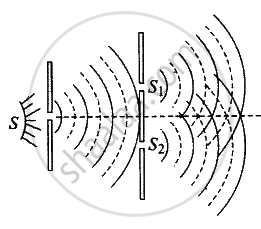
Figure shows a standard two slit arrangement with slits S1, S2, P1, P2 are the two minima points on either side of P (Figure). At P2 on the screen, there is a hole and behind P2 is a second 2-slit arrangement with slits S3, S4 and a second screen behind them.

विकल्प
There would be no interference pattern on the second screen but it would be lighted.
The second screen would be totally dark.
There would be a single bright point on the second screen.
There would be a regular two slit pattern on the second screen.
Advertisements
उत्तर
There would be a regular two slit pattern on the second screen.
Explanation:
Every point on the given wave front acts as a source of new disturbance called secondary wavelets which travel in all directions with the velocity of light in the medium.
A surface touching these secondary wavelets tangentially in the forward direction at any instant gives the new wavefront at that instant. This is called secondary wavefront. In the given question, there is a hole at point which is a maxima point. From Huygen’s principle, wave will propagate from the sources S1 and S2. Each point on the screen will act as secondary source of wavelets.

The wavefront emitted by a narrow source is divided into two parts reflection, refraction or diffraction. The coherent sources so obtained are imaginary.
APPEARS IN
संबंधित प्रश्न
On the basis of Huygens' wave theory of light prove that velocity of light in a rarer medium is greater than velocity of light in a denser medium.
Using Huygens's construction of secondary wavelets explain how a diffraction pattern is obtained on a screen due to a narrow slit on which a monochromatic beam of light is incident normally.
The refractive indices of water and diamond are `4/3` and 2.42 respectively. Find the speed of light in water and diamond. (c = 3x10⁸ m/s)
According to Huygens principle, ______.
According to Huygen's construction, relation between old and new wavefront is ______.
For light diverging from a point source ______.
- the wavefront is spherical.
- the intensity decreases in proportion to the distance squared.
- the wavefront is parabolic.
- the intensity at the wavefront does not depend on the distance.
What is the shape of the wavefront on earth for sunlight?
According to Huygens’s principle, the amplitude of secondary wavelets is ______.
What type of wavefronts are associated with a source infinity?
What type of wavefronts are associated with a point source of light?
Represent diagrammatically how the incident planar wavefronts of wavelength λ pass through an aperture of size d, when d is approximately equal to λ.
When can a small portion of a spherical wave be considered as a plane?
Which book by Christiaan Huygens is cited as an important work?
How does every point on the surface of a calm pool respond after a small stone is dropped into it?
What is meant by the speed of the wave?
Given the shape of a wavefront at any time, what does Huygens' principle allow to be determined?
What shortcoming does Huygens' model have?
What did Huygens explain by assuming zero amplitude of secondary wavelets in the backward direction?
For what other type of wavefront can Huygens' principle determine the shape during propagation through a medium?
