Advertisements
Advertisements
Question
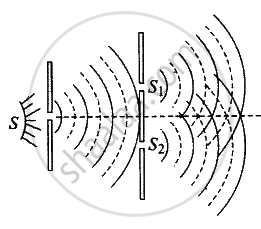
Figure shows a standard two slit arrangement with slits S1, S2, P1, P2 are the two minima points on either side of P (Figure). At P2 on the screen, there is a hole and behind P2 is a second 2-slit arrangement with slits S3, S4 and a second screen behind them.

Options
There would be no interference pattern on the second screen but it would be lighted.
The second screen would be totally dark.
There would be a single bright point on the second screen.
There would be a regular two slit pattern on the second screen.
Advertisements
Solution
There would be a regular two slit pattern on the second screen.
Explanation:
Every point on the given wave front acts as a source of new disturbance called secondary wavelets which travel in all directions with the velocity of light in the medium.
A surface touching these secondary wavelets tangentially in the forward direction at any instant gives the new wavefront at that instant. This is called secondary wavefront. In the given question, there is a hole at point which is a maxima point. From Huygen’s principle, wave will propagate from the sources S1 and S2. Each point on the screen will act as secondary source of wavelets.

The wavefront emitted by a narrow source is divided into two parts reflection, refraction or diffraction. The coherent sources so obtained are imaginary.
APPEARS IN
RELATED QUESTIONS
On the basis of Huygens' wave theory of light prove that velocity of light in a rarer medium is greater than velocity of light in a denser medium.
Using Huygens's construction of secondary wavelets explain how a diffraction pattern is obtained on a screen due to a narrow slit on which a monochromatic beam of light is incident normally.
Derive the law of reflection using Huygen’s Wave Theory.
According to Huygen's construction, relation between old and new wavefront is ______.
What is the geometrical shape of the wavefront for:
- Light diverging from a point source?
- The pattern of wavefront of the light from a distant star intercepted by earth?
Answer the following question briefly and to the point:
What is the phase difference between any two points lying on the same wavefront?
The inverse square law of intensity is valid for a
Wavefront means
Is Huygen’s principle valid for longitudinal sound waves?
What type of wavefronts are associated with a source infinity?
Who was the founder of the wave theory of light?
Which book by Christiaan Huygens is cited as an important work?
What improved devices did Christiaan Huygens design?
What is meant by the speed of the wave?
In what direction does the energy of a wave travel relative to its wavefront?
Given the shape of a wavefront at any time, what does Huygens' principle allow to be determined?
What did Huygens argue about the amplitude of secondary wavelets?
How is Huygens' adhoc assumption about the backwave assessed?
What really justifies the absence of the backwave?
