Advertisements
Advertisements
Question
Derive the law of reflection using Huygen’s Wave Theory.
Advertisements
Solution
Huygen’s wave theory :
Reflection at a plane surface : Consider a plane reflecting surface XY. Let AB be a plane wavefront of light incident obliquely on XY. When the incident wavefront touches XY at A, a secondary wavelet starts, spreading from A according to Huygens’ principle. Let the ray at B reach XY at D after a time t. If v is the speed of light in air then BD = vt. During this time t, the secondary wavelet from A spreads over a hemisphere of radius vt. with centre at A. Let CD be a tangent to this hemisphere. Then AC = BD. C and D are in the same phase. If we consider all the points between A and D, then CD will be tangential to all the secondary wavelets originating from these points at the end of t seconds. Hence CD is the reflected wavefront.

Draw AN normal to XY. Then
`anglePAN = i` , the angle of incidence , and `angleNAC = r` the angle of reflection
In triangles BAD and CDA
AC = BD = vt; AD is common, and `angleABD = angleACD = 90^circ` because the rays are normal to wavefronts.
`therefore` Triangles BAD and CDA are congruent
`therefore angleDAC = angleBDA , 90^circ - r = 90^circ - i`
OR `therefore i = r`
i.e , angle of incidence is equal to angle of reflection .
APPEARS IN
RELATED QUESTIONS
The refractive indices of water and diamond are `4/3` and 2.42 respectively. Find the speed of light in water and diamond. (c = 3x10⁸ m/s)
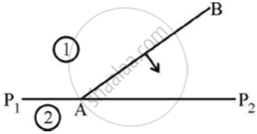
A plane wave front AB propagating from denser medium (1) into a rarer medium (2) is incident on the surface P1P2 separating the two media as shown in fig.
Using Huygen’s principle, draw the secondary wavelets and obtain the refracted wave front in the diagram.
Represent diagrammatically how the incident planar wavefronts of wavelength λ pass through an aperture of size d, when d is approximately equal to λ.
Who was the founder of the wave theory of light?
How does every point on the surface of a calm pool respond after a small stone is dropped into it?
What is a locus of points which oscillate in phase called?
In Huygens' principle, what does each point of the wavefront act as?
What shortcoming does Huygens' model have?
What did Huygens explain by assuming zero amplitude of secondary wavelets in the backward direction?
What really justifies the absence of the backwave?
