Advertisements
Advertisements
Question
Light waves travel in vacuum along the X-axis. Which of the following may represent the wave fronts?
Options
x = c
y = c
z = c
x + y + z = c
Advertisements
Solution
x = c
The wave is travelling along the X-axis. So, it'll have planar wavefront perpendicular to the X-axis.
APPEARS IN
RELATED QUESTIONS
On the basis of Huygens' wave theory of light prove that velocity of light in a rarer medium is greater than velocity of light in a denser medium.
Explain the construction of plane wavefront using Huygens’ principle.
What is the shape of the wavefront in the following case?
Light emerging out of a convex lens when a point source is placed at its focus.
Consider a plane wave front incident on a thin convex lens. Draw a proper diagram to show how the incident wave front traverses through the lens and after refraction focusses on the focal point of the lens, giving the shape of the emergent wave front.
Using Huygens’ principle, verify the laws of reflection at a plane surface.
Using this principle draw a diagram to show how a plane wave front incident at the interface of the two media gets refracted when it propagates from a rarer to a denser medium. Hence verify Snell's law of refraction.
When the width of the slit is made double the original width, how would this affect the size and intensity of the central diffraction band?
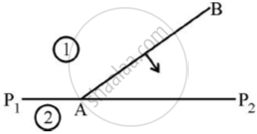
A plane wave front AB propagating from denser medium (1) into a rarer medium (2) is incident on the surface P1P2 separating the two media as shown in fig.
Using Huygen’s principle, draw the secondary wavelets and obtain the refracted wave front in the diagram.
Relation between ray and wavefront is ______.
Huygen's conception of secondary waves ______.
According to Huygens’s principle, the amplitude of secondary wavelets is ______.
How is a wavefront different from a ray?
Which types of motion was Christiaan Huygens the first to analyse?
How does every point on the surface of a calm pool respond after a small stone is dropped into it?
What is a locus of points which oscillate in phase called?
In Huygens' principle, what does each point of the wavefront act as?
How do wavelets emanating from points on a wavefront spread?
What did Huygens argue about the amplitude of secondary wavelets?
For what other type of wavefront can Huygens' principle determine the shape during propagation through a medium?
