Advertisements
Advertisements
Question
Explain the construction of plane wavefront using Huygens’ principle.
Advertisements
Solution

a. A plane wavefront is formed when point of observation is very far away from the primary source.
b. Let PQR represent a plane wavefront at any instant. According to Huygens’ principle,all the points on this wavefront will act as secondary sources of light sending out secondary wavelets in the forward direction.
c. Draw hemispheres with P, Q, R…. as centres and ‘ct’ as radius. The surface tangential
to all such hemispheres is P1Q1R1…. at instant ‘t’. It is a new wavefront at time ‘t’.
d. The plane wavefronts is propagated as plane waves in homogeneous isotropic medium.They are parallel to each other.
e. PP1N1, QQ1N2, RR1N3 are the wave normals at P, Q, R respectively. These wave normals show the direction of propagation of plane wavefront.
f. The new wavefront P1Q1R1 is parallel to primary wavefront PQR.
APPEARS IN
RELATED QUESTIONS
On the basis of Huygens' wave theory of light prove that velocity of light in a rarer medium is greater than velocity of light in a denser medium.
What is the shape of the wavefront in the following case?
Light emerging out of a convex lens when a point source is placed at its focus.
What is the shape of the wavefront in the following case?
The portion of the wavefront of light from a distant star was intercepted by the Earth.
You have learnt in the text how Huygens’ principle leads to the laws of reflection and refraction. Use the same principle to deduce directly that a point object placed in front of a plane mirror produces a virtual image whose distance from the mirror is equal to the object distance from the mirror.
State Huygen’s principle.
Using this principle draw a diagram to show how a plane wave front incident at the interface of the two media gets refracted when it propagates from a rarer to a denser medium. Hence verify Snell's law of refraction.
Use Huygens’s principle to explain the formation of diffraction pattern due to a single slit illuminated by a monochromatic source of light.
When the width of the slit is made double the original width, how would this affect the size and intensity of the central diffraction band?
Huygens' principle of secondary wavelets may be used to
(a) find the velocity of light in vacuum
(b) explain the particle behaviour of light
(c) find the new position of a wavefront
(d) explain Snell's Law
With what type of source of light are cylindrical wave fronts associated?
Define the term wavefront. Using Huygen’s wave theory, verify the law of reflection.
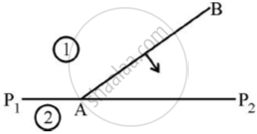
A plane wave front AB propagating from denser medium (1) into a rarer medium (2) is incident on the surface P1P2 separating the two media as shown in fig.
Using Huygen’s principle, draw the secondary wavelets and obtain the refracted wave front in the diagram.
According to Huygens principle, ______.
Wavefront means
Huygen's conception of secondary waves ______.
For light diverging from a point source ______.
- the wavefront is spherical.
- the intensity decreases in proportion to the distance squared.
- the wavefront is parabolic.
- the intensity at the wavefront does not depend on the distance.
Consider a point at the focal point of a convergent lens. Another convergent lens of short focal length is placed on the other side. What is the nature of the wavefronts emerging from the final image?
What is the shape of the wavefront on earth for sunlight?
According to Huygens’s principle, the amplitude of secondary wavelets is ______.
What type of wavefronts are associated with a source infinity?
Using Huygen’s wave theory of light, show that the angle of incidence is equal to the angle of reflection. Draw a neat and labelled diagram.
What type of wavefronts are associated with a point source of light?
Represent diagrammatically how the incident planar wavefronts of wavelength λ pass through an aperture of size d, when d is approximately equal to λ.
Represent diagrammatically how the incident planar wavefronts of wavelength λ pass through an aperture of size d, when d is approximately equal to λ.
What is a wavefront?
Who was the founder of the wave theory of light?
Which book by Christiaan Huygens is cited as an important work?
What did Christiaan Huygens explain in addition to reflection and refraction?
Which types of motion was Christiaan Huygens the first to analyse?
What did Christiaan Huygens discover about Saturn?
At any instant, where is the disturbance maximum on the surface of the water?
What is meant by the speed of the wave?
In what direction does the energy of a wave travel relative to its wavefront?
What kind of construction is Huygens' principle essentially?
In Huygens' principle, what does each point of the wavefront act as?
How do wavelets emanating from points on a wavefront spread?
What are the wavelets emanating from points on a wavefront called?
What role does each point of a spherical wavefront play in constructing its later position?
What did Huygens argue about the amplitude of secondary wavelets?
How is Huygens' adhoc assumption about the backwave assessed?
What really justifies the absence of the backwave?
For what other type of wavefront can Huygens' principle determine the shape during propagation through a medium?
