Advertisements
Advertisements
Question
Define the term wavefront. Using Huygen’s wave theory, verify the law of reflection.
Advertisements
Solution
In a region where the wave is propagating, the geometrical structure formed by joining all the points which are vibrating in same (absolute) phase are said to be wavefront Reflection of plane wave :

Consider a plane wave ABC incident at an angle ‘i’ on a reflecting surface ‘AD’. If v represents the speed of the wave in medium Δt is the time taken to move from ABC to B1C1 and also from B1C1 to point ‘D’. So, at the time when a disturbance of point ‘C’ reaches to point ‘D’ disturbance of point ‘A’ must have formed a hemispherical shape of radius 2vΔt and at point ‘B1’ it must have formed a hemispherical shape of radius vΔt. Drawing a common tangent from point ‘D’ to both of the above mentioned spherical envelopes we shall have DEF as reflected wavefront. Now, in ΔACD and ΔDFA
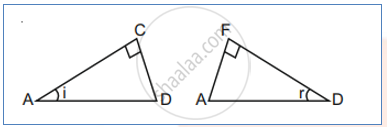
Side AD = AD and side CD = AF = 2vΔt
And ∠ACD = ∠DFA = 90°
so by RHS rule, both the triangles are congruent. Hence each corresponding parameter must be the same. Hence ∠CAD = i (angle of incidence) Must be the same as ∠FDA = r (angle of reflection) ∠i = ∠r
APPEARS IN
RELATED QUESTIONS
Use Huygens’s principle to explain the formation of diffraction pattern due to a single slit illuminated by a monochromatic source of light.
Derive the law of reflection using Huygen’s Wave Theory.
According to Huygen's construction, relation between old and new wavefront is ______.
For light diverging from a point source ______.
- the wavefront is spherical.
- the intensity decreases in proportion to the distance squared.
- the wavefront is parabolic.
- the intensity at the wavefront does not depend on the distance.
Is Huygen’s principle valid for longitudinal sound waves?
Represent diagrammatically how the incident planar wavefronts of wavelength λ pass through an aperture of size d, when d is approximately equal to λ.
Represent diagrammatically how the incident planar wavefronts of wavelength λ pass through an aperture of size d, when d is approximately equal to λ.
Why are all points on a circular ring of the water wave oscillating in phase?
In what direction does the energy of a wave travel relative to its wavefront?
How do wavelets emanating from points on a wavefront spread?
