Advertisements
Advertisements
प्रश्न
Define the term wavefront. Using Huygen’s wave theory, verify the law of reflection.
Advertisements
उत्तर
In a region where the wave is propagating, the geometrical structure formed by joining all the points which are vibrating in same (absolute) phase are said to be wavefront Reflection of plane wave :

Consider a plane wave ABC incident at an angle ‘i’ on a reflecting surface ‘AD’. If v represents the speed of the wave in medium Δt is the time taken to move from ABC to B1C1 and also from B1C1 to point ‘D’. So, at the time when a disturbance of point ‘C’ reaches to point ‘D’ disturbance of point ‘A’ must have formed a hemispherical shape of radius 2vΔt and at point ‘B1’ it must have formed a hemispherical shape of radius vΔt. Drawing a common tangent from point ‘D’ to both of the above mentioned spherical envelopes we shall have DEF as reflected wavefront. Now, in ΔACD and ΔDFA
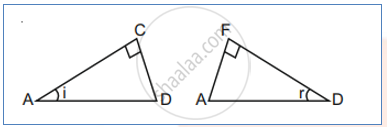
Side AD = AD and side CD = AF = 2vΔt
And ∠ACD = ∠DFA = 90°
so by RHS rule, both the triangles are congruent. Hence each corresponding parameter must be the same. Hence ∠CAD = i (angle of incidence) Must be the same as ∠FDA = r (angle of reflection) ∠i = ∠r
APPEARS IN
संबंधित प्रश्न
State Huygen’s principle.
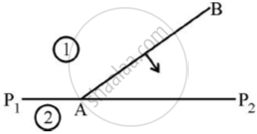
A plane wave front AB propagating from denser medium (1) into a rarer medium (2) is incident on the surface P1P2 separating the two media as shown in fig.
Using Huygen’s principle, draw the secondary wavelets and obtain the refracted wave front in the diagram.
The inverse square law of intensity is valid for a
Is Huygen’s principle valid for longitudinal sound waves?
When can a small portion of a spherical wave be considered as a plane?
Which book by Christiaan Huygens is cited as an important work?
What improved devices did Christiaan Huygens design?
At any instant, where is the disturbance maximum on the surface of the water?
In Huygens' principle, what does each point of the wavefront act as?
What role does each point of a spherical wavefront play in constructing its later position?
