Advertisements
Advertisements
Question
You have learnt in the text how Huygens’ principle leads to the laws of reflection and refraction. Use the same principle to deduce directly that a point object placed in front of a plane mirror produces a virtual image whose distance from the mirror is equal to the object distance from the mirror.
Advertisements
Solution
Let an object at O be placed in front of a plane mirror MO’ at a distance r (as shown in the given figure).
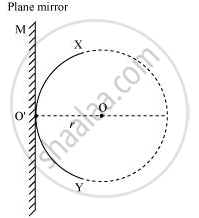
A circle is drawn from the centre (O) such that it just touches the plane mirror at point O’. According to Huygens’ Principle, XY is the wavefront of incident light.
If the mirror is absent, then a similar wavefront X’Y’ (as XY) would form behind O’ at distance r (as shown in the given figure).
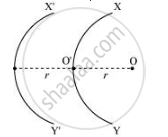
X'Y' can be considered as a virtual reflected ray for the plane mirror. Hence, a point object placed in front of the plane mirror produces a virtual image whose distance from the mirror is equal to the object distance (r).
APPEARS IN
RELATED QUESTIONS
What is the shape of the wavefront in the following case?
Light diverging from a point source.
What is the shape of the wavefront in the following case?
The portion of the wavefront of light from a distant star was intercepted by the Earth.
State Huygen’s principle.
Use Huygens' principle to verify the laws of refraction.
The refractive indices of water and diamond are `4/3` and 2.42 respectively. Find the speed of light in water and diamond. (c = 3x10⁸ m/s)
Use Huygens’s principle to explain the formation of diffraction pattern due to a single slit illuminated by a monochromatic source of light.
When the width of the slit is made double the original width, how would this affect the size and intensity of the central diffraction band?
State Huygens’s principle. Show, with the help of a suitable diagram, how this principle is used to obtain the diffraction pattern by a single slit.
Draw a plot of intensity distribution and explain clearly why the secondary maxima becomes weaker with increasing order (n) of the secondary maxima.
With what type of source of light are cylindrical wave fronts associated?
Define a wavefront. Using 'Huygens' principle, draw the shape of a refracted wavefront, when a plane wave is incident on a convex lens.
Answer the following question briefly and to the point:
What is the phase difference between any two points lying on the same wavefront?
Huygen's conception of secondary waves ______.
Two light beams of intensities in the ratio of 9 : 4 are allowed to interfere. The ratio of the intensity of maxima and minima ______.
Which book by Christiaan Huygens is cited as an important work?
Which types of motion was Christiaan Huygens the first to analyse?
What kind of construction is Huygens' principle essentially?
How do wavelets emanating from points on a wavefront spread?
What gives the new position of a wavefront at a later time in Huygens' construction?
