Advertisements
Advertisements
प्रश्न
You have learnt in the text how Huygens’ principle leads to the laws of reflection and refraction. Use the same principle to deduce directly that a point object placed in front of a plane mirror produces a virtual image whose distance from the mirror is equal to the object distance from the mirror.
Advertisements
उत्तर
Let an object at O be placed in front of a plane mirror MO’ at a distance r (as shown in the given figure).
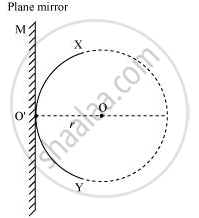
A circle is drawn from the centre (O) such that it just touches the plane mirror at point O’. According to Huygens’ Principle, XY is the wavefront of incident light.
If the mirror is absent, then a similar wavefront X’Y’ (as XY) would form behind O’ at distance r (as shown in the given figure).
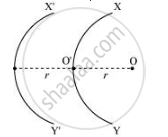
X'Y' can be considered as a virtual reflected ray for the plane mirror. Hence, a point object placed in front of the plane mirror produces a virtual image whose distance from the mirror is equal to the object distance (r).
APPEARS IN
संबंधित प्रश्न
On the basis of Huygens' wave theory of light prove that velocity of light in a rarer medium is greater than velocity of light in a denser medium.
Explain the construction of plane wavefront using Huygens’ principle.
Consider a plane wave front incident on a thin convex lens. Draw a proper diagram to show how the incident wave front traverses through the lens and after refraction focusses on the focal point of the lens, giving the shape of the emergent wave front.
Use Huygens' principle to verify the laws of refraction.
Using this principle draw a diagram to show how a plane wave front incident at the interface of the two media gets refracted when it propagates from a rarer to a denser medium. Hence verify Snell's law of refraction.
Define the term wavefront. Using Huygen’s wave theory, verify the law of reflection.
According to Huygen's construction, relation between old and new wavefront is ______.
Wavefront means
For light diverging from a point source ______.
- the wavefront is spherical.
- the intensity decreases in proportion to the distance squared.
- the wavefront is parabolic.
- the intensity at the wavefront does not depend on the distance.
Is Huygen’s principle valid for longitudinal sound waves?
Consider a point at the focal point of a convergent lens. Another convergent lens of short focal length is placed on the other side. What is the nature of the wavefronts emerging from the final image?
What is the shape of the wavefront on earth for sunlight?
Two light beams of intensities in the ratio of 9 : 4 are allowed to interfere. The ratio of the intensity of maxima and minima ______.
According to Huygens’s principle, the amplitude of secondary wavelets is ______.
Using Huygen’s wave theory of light, show that the angle of incidence is equal to the angle of reflection. Draw a neat and labelled diagram.
Represent diagrammatically how the incident planar wavefronts of wavelength λ pass through an aperture of size d, when d is approximately equal to λ.
What is a wavefront?
What is meant by the speed of the wave?
Given the shape of a wavefront at any time, what does Huygens' principle allow to be determined?
