Advertisements
Advertisements
प्रश्न
Define a wavefront. Using 'Huygens' principle, draw the shape of a refracted wavefront, when a plane wave is incident on a convex lens.
Advertisements
उत्तर
The locus of points, which oscillate in phase is called a wavefront; thus a wavefront is defined as a surface of constant phase.
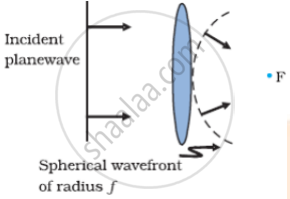
In the given figure we consider a plane wave incident on a thin convex lens, the emerging wavefront is spherical and converges to point F which is known as the focus.
APPEARS IN
संबंधित प्रश्न
The refractive indices of water and diamond are `4/3` and 2.42 respectively. Find the speed of light in water and diamond. (c = 3x10⁸ m/s)
Use Huygens’s principle to explain the formation of diffraction pattern due to a single slit illuminated by a monochromatic source of light.
Wavefront means
According to Huygens’s principle, the amplitude of secondary wavelets is ______.
What improved devices did Christiaan Huygens design?
How does every point on the surface of a calm pool respond after a small stone is dropped into it?
At any instant, where is the disturbance maximum on the surface of the water?
What is meant by the speed of the wave?
In what direction does the energy of a wave travel relative to its wavefront?
What kind of construction is Huygens' principle essentially?
