Advertisements
Advertisements
प्रश्न
Using Huygens’ principle, verify the laws of reflection at a plane surface.
Advertisements
उत्तर
Verification of Laws of Reflection using Huygens Principle

Consider any point Q on the incident wavefront PA.
When the disturbance from P on incident wavefront reaches point P', the disturbance from point Q reaches Q'
If c is the velocity of light, then the time taken by light to go from point Q to Q' (via point K) is given by,
`t = (QK)/c + (KQ')/c `....(i)
In right-angled ΔAQK,
∠QAK = i
∴ QK = AK sin i
In right-angled ΔKQ'P'
∠Q'P'K = r
`:. KQ' = KP' sin r`
Substituting these values in equation (1),
`t = (AK sin i)/c + (KP'sin r)/c`
`t = (AK sin i + (AP' - AK)sin r)/c` (∵ KP' = AP' - AK)
`t = (AP' sin r + AK(sin i - sin r))/c` ...(ii)
The rays from different points on incident wavefront will take the same time to reach the corresponding points on the reflected wavefront if ‘t’ given by equation (ii) is independent of AK
∴ AK (sin i − sin r) = 0
sin i − sin r = 0
sin i = sin r
i = r
i.e the angle of incidence is equal to the angle of reflection
Also, the incident ray (LA or MP'), reflected ray (AA'L' or P'M'), and the normal (AN) − all lie in the same plane.
APPEARS IN
संबंधित प्रश्न
The refractive indices of water and diamond are `4/3` and 2.42 respectively. Find the speed of light in water and diamond. (c = 3x10⁸ m/s)
Use Huygens’s principle to explain the formation of diffraction pattern due to a single slit illuminated by a monochromatic source of light.
Define the term wavefront. Using Huygen’s wave theory, verify the law of reflection.
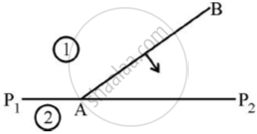
A plane wave front AB propagating from denser medium (1) into a rarer medium (2) is incident on the surface P1P2 separating the two media as shown in fig.
Using Huygen’s principle, draw the secondary wavelets and obtain the refracted wave front in the diagram.
Answer the following question briefly and to the point:
What is the phase difference between any two points lying on the same wavefront?
What is the shape of the wavefront on earth for sunlight?
What type of wavefronts are associated with a source infinity?
Represent diagrammatically how the incident planar wavefronts of wavelength λ pass through an aperture of size d, when d is approximately equal to λ.
Who was the founder of the wave theory of light?
What did Christiaan Huygens explain in addition to reflection and refraction?
