Advertisements
Advertisements
Question
Use Huygens' principle to verify the laws of refraction.
Advertisements
Solution
Huygens' Principle to Verify the Laws of Refraction :
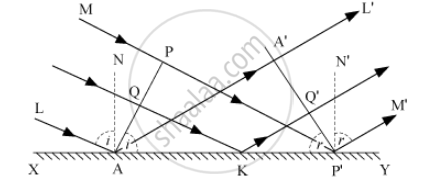
Consider any point Q on the incident wavefront PA.
When the disturbance from P on incident wavefront reaches point P', the disturbance from point Q reaches Q'.
If c is velocity of light, then time taken by light to go from point Q to Q'(via point K) is given by,
`t=(QK)/c+(KQ')/c`....(i)
In right-angled ΔAQK,
∠QAK = i
∴ QK = AK sin i
In right-angled ΔKQ'P'
∠Q'P'K=r
∴ KQ'=KP'sin r
Substituting these values in equation (i),
`t=(AKsini)/c+(KP'sinr)/c`
`t=(AKsini+KP'sinr)/c`
`t=(AKsini+(AP'-AK)sinr)/c` [∵ KP'=AP'-AK]
`t=(AP'sinr+AK(sini-sinr))/c` .....(ii)
The rays from different points on incident wavefront will take the same time to reach the corresponding points on the reflected wavefront, if ‘t’ given by equation (ii) is independent of AK.
∴ AK (sin i − sin r) = 0
sin i − sin r = 0
sin i = sin r
i = r
i.e., the angle of incidence is equal to the angle of reflection.
Also, the incident ray (LA or MP'), reflected ray (AA'L' or P'M'), and the normal (AN) − all lie in the same plane.
RELATED QUESTIONS
Using Huygens's construction of secondary wavelets explain how a diffraction pattern is obtained on a screen due to a narrow slit on which a monochromatic beam of light is incident normally.
What is the shape of the wavefront in the following case?
Light emerging out of a convex lens when a point source is placed at its focus.
With what type of source of light are cylindrical wave fronts associated?
Relation between ray and wavefront is ______.
Using Huygen’s wave theory of light, show that the angle of incidence is equal to the angle of reflection. Draw a neat and labelled diagram.
What type of wavefronts are associated with a point source of light?
Represent diagrammatically how the incident planar wavefronts of wavelength λ pass through an aperture of size d, when d is approximately equal to λ.
Represent diagrammatically how the incident planar wavefronts of wavelength λ pass through an aperture of size d, when d is approximately equal to λ.
What is a wavefront?
What did Christiaan Huygens discover about Saturn?
