Advertisements
Advertisements
प्रश्न
Use Huygens’s principle to explain the formation of diffraction pattern due to a single slit illuminated by a monochromatic source of light.
Advertisements
उत्तर
Consider a parallel beam of monochromatic light is incident normally in a slit of width b as shown if figure. According to Huygens’s principle every point of slit acts as a source of secondary wavelets spreading in all directions. Screen is placed at a larger distance.
Consider a particular point P on the screen receives waves from all the secondary sources. All these waves start from different point of the slit and interface at point P to give
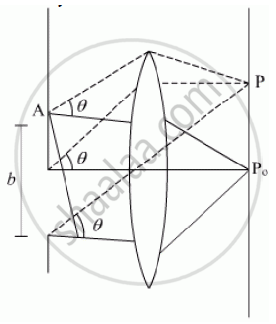
Point P0 is at bisector plane of the slit. At P0, all waves are traveling equal optical path. So are in phase the waves thus interface constructively with each other and maximum intensity is observed. As we move from P0, the wave arrives with different phase and intensity is changed. Intensity at point P is given by
`I = I_0 (sin^2α)/alpha`
where `alpha = pi/lambda b sin theta`
For central maxima α = 0 thus,
I = I0
APPEARS IN
संबंधित प्रश्न
On the basis of Huygens' wave theory of light prove that velocity of light in a rarer medium is greater than velocity of light in a denser medium.
Answer the following question briefly and to the point:
What is the phase difference between any two points lying on the same wavefront?
The inverse square law of intensity is valid for a
Figure shows a standard two slit arrangement with slits S1, S2, P1, P2 are the two minima points on either side of P (Figure). At P2 on the screen, there is a hole and behind P2 is a second 2-slit arrangement with slits S3, S4 and a second screen behind them.

Is Huygen’s principle valid for longitudinal sound waves?
Consider a point at the focal point of a convergent lens. Another convergent lens of short focal length is placed on the other side. What is the nature of the wavefronts emerging from the final image?
What is a wavefront?
Who was the founder of the wave theory of light?
What happens when a small stone is dropped on a calm pool of water?
What really justifies the absence of the backwave?
