Advertisements
Advertisements
प्रश्न
In Young’s double slit experiment using monochromatic light of wavelength λ, the intensity of light at a point on the screen where path difference is λ, is K units. Find out the intensity of light at a point where path difference is λ/3.
Advertisements
उत्तर
We know
Phase difference `= ((2pi)/lambda) xx` path difference
At path difference λ
Phase difference ,`phi = (2pi)/lambda xx lambda = 2pi`
Intensity, `I = 4I_0 cos^2 phi/2`
or ,` K = 4I_0 cos^2 (2pi)/2` [given I = K at path difference λ]
or, `K = 4I_0`
or ,`I_0 = K/4`
Now, at path difference `= lambda/3`
`phi' = (2pi)/lambda xx lambda/3 = (2pi)/3`
Intensity , `I' =4I_0 cos^2 1/2 ((2pi)/3)`
0r, `I' = 4 xx K/4 cos^2 pi/3`
`I'=K/4`
APPEARS IN
संबंधित प्रश्न
Show that the angular width of the first diffraction fringe is half that of the central fringe.
In Young’s double slit experiment, show graphically how the intensity of light varies with distance
How does an unpolarized light incident on a polaroid get polarized? Describe briefly, with the help of a necessary diagram, the polarization of light by reflection from a transparent medium.
The slits in a Young's double slit experiment have equal width and the source is placed symmetrically with respect to the slits. The intensity at the central fringe is I0. If one of the slits is closed, the intensity at this point will be ____________ .
A thin transparent sheet is placed in front of a Young's double slit. The fringe-width will _____________ .
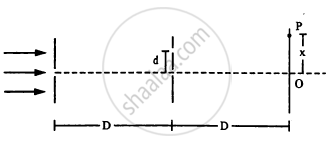
Consider the arrangement shown in the figure. The distance D is large compared to the separation d between the slits.
- Find the minimum value of d so that there is a dark fringe at O.
- Suppose d has this value. Find the distance x at which the next bright fringe is formed.
- Find the fringe-width.
In Young’s double-slit experiment, using monochromatic light, fringes are obtained on a screen placed at some distance from the slits. If the screen is moved by 5 x 10⁻² m towards the slits, the change in the fringe width is 3 x 10⁻⁵ m. If the distance between the two slits is 10-3 m, calculate the wavelength of the light used.
The Young's double slit experiment is performed with blue and with green light of wavelengths 4360Å and 5460Å respectively. If x is the distance of 4th maxima from the central one, then:
A beam of light consisting of two wavelengths 600 nm and 500 nm is used in Young's double slit experiment. The silt separation is 1.0 mm and the screen is kept 0.60 m away from the plane of the slits. Calculate:
- the distance of the second bright fringe from the central maximum for wavelength 500 nm, and
- the least distance from the central maximum where the bright fringes due to both wavelengths coincide.
Why does the phase difference between light from ordinary sources change randomly?
