Advertisements
Advertisements
प्रश्न
In Young’s double slit experiment using monochromatic light of wavelength λ, the intensity of light at a point on the screen where path difference is λ, is K units. Find out the intensity of light at a point where path difference is λ/3.
Advertisements
उत्तर
We know
Phase difference `= ((2pi)/lambda) xx` path difference
At path difference λ
Phase difference ,`phi = (2pi)/lambda xx lambda = 2pi`
Intensity, `I = 4I_0 cos^2 phi/2`
or ,` K = 4I_0 cos^2 (2pi)/2` [given I = K at path difference λ]
or, `K = 4I_0`
or ,`I_0 = K/4`
Now, at path difference `= lambda/3`
`phi' = (2pi)/lambda xx lambda/3 = (2pi)/3`
Intensity , `I' =4I_0 cos^2 1/2 ((2pi)/3)`
0r, `I' = 4 xx K/4 cos^2 pi/3`
`I'=K/4`
APPEARS IN
संबंधित प्रश्न
The fringes produced in diffraction pattern are of _______.
(A) equal width with same intensity
(B) unequal width with varying intensity
(C) equal intensity\
(D) equal width with varying intensity
White light is used in a Young's double slit experiment. Find the minimum order of the violet fringe \[\left( \lambda = 400\text{ nm} \right)\] which overlaps with a red fringe \[\left( \lambda = 700\text{ nm} \right).\]
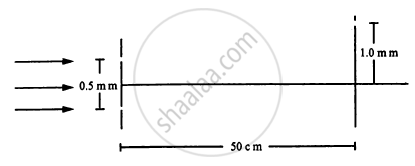
White coherent light (400 nm-700 nm) is sent through the slits of a Young's double slit experiment (see the following figure). The separation between the slits is 0⋅5 mm and the screen is 50 cm away from the slits. There is a hole in the screen at a point 1⋅0 mm away (along the width of the fringes) from the central line. (a) Which wavelength(s) will be absent in the light coming from the hole? (b) Which wavelength(s) will have a strong intensity?
In a Young's double slit interference experiment, the fringe pattern is observed on a screen placed at a distance D from the slits. The slits are separated by a distance d and are illuminated by monochromatic light of wavelength \[\lambda.\] Find the distance from the central point where the intensity falls to (a) half the maximum, (b) one-fourth the maximum.
"If the slits in Young's double slit experiment are identical, then intensity at any point on the screen may vary between zero and four times to the intensity due to single slit".
Justify the above statement through a relevant mathematical expression.
Consider a two-slit interference arrangement (Figure) such that the distance of the screen from the slits is half the distance between the slits. Obtain the value of D in terms of λ such that the first minima on the screen falls at a distance D from the centre O.

ASSERTION (A): In an interference pattern observed in Young's double slit experiment, if the separation (d) between coherent sources as well as the distance (D) of the screen from the coherent sources both are reduced to 1/3rd, then new fringe width remains the same.
REASON (R): Fringe width is proportional to (d/D).
What did Young's double-slit experiment provide strong evidence for?
What is a fringe?
Why do the two narrow slits in Young's experiment act as coherent sources?
