Advertisements
Advertisements
प्रश्न
In Young’s double-slit experiment, show that:
`beta = (lambda "D")/"d"` where the terms have their usual meaning.
Advertisements
उत्तर
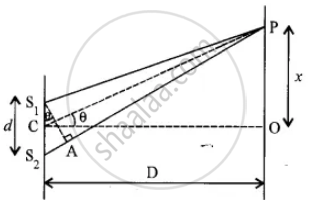
d = Distance between the slits
D = Distance between slit and screen
'P' is the position of mth order bright fringe.
From diagram, the path difference p is
S2P - S1P = S2P - AP
= S2A
`"sin"theta = ("S"_2"A")/("S"_1"S"_2)` [From Δ S1AS2]
`"tan" theta = "OP"/"CO"` [From Δ POC]
θ → 0 ∴ sin θ ≅ tan θ
∴ `("S"_2"A")/("S"_1"S"_2) = "OP"/"OC"`
`therefore ("S"_2"A")/"d" = "x"/"D"`
`therefore "S"_2"A" = "x d"/"D"`
or p = `"x" "d"/"D"`
∴ For bright fringe,
`"x d"/"D" = "m" lambda`, where m is an integer
∴ xm = `("m"lambda"D")/"d"`
∴ xm+1 = (m + 1) `(lambda"D")/"d"`
∴ Fringe width β = [(m + 1)-m] `(lambda"D")/"d"`
β = `(lambda"D")/"d"`
APPEARS IN
संबंधित प्रश्न
A beam of light consisting of two wavelengths, 650 nm and 520 nm, is used to obtain interference fringes in a Young’s double-slit experiment.
What is the least distance from the central maximum where the bright fringes due to both the wavelengths coincide?
The fringes produced in diffraction pattern are of _______.
(A) equal width with same intensity
(B) unequal width with varying intensity
(C) equal intensity\
(D) equal width with varying intensity
In Young’s double-slit experiment, using monochromatic light, fringes are obtained on a screen placed at some distance from the slits. If the screen is moved by 5 x 10⁻² m towards the slits, the change in the fringe width is 3 x 10⁻⁵ m. If the distance between the two slits is 10-3 m, calculate the wavelength of the light used.
The force required to double the length of a steel wire of area 1 cm2, if its Young's modulus Y= 2 × 10¹¹/m2 is:
A fringe width of 6 mm was produced for two slits separated by 1 mm apart. The screen is placed 10 m away. The wavelength of light used is 'x' nm. The value of 'x' to the nearest integer is ______.
The central fringe of the interference pattern produced by the light of wavelength 6000 Å is found to shift to the position of the fourth bright fringe after a glass plate of refractive index 1.5 is introduced in the path of one of the beams. The thickness of the glass plate would be ______.
In Young's double slit experiment, the distance of the 4th bright fringe from the centre of the interference pattern is 1.5 mm. The distance between the slits and the screen is 1.5 m, and the wavelength of light used is 500 nm. Calculate the distance between the two slits.
In Young's double slit experiment, show that:
`β = (λ"D")/"d"`
Where the terms have their usual meaning.
What is the consequence of random phase variation for ordinary light sources?
What is required to obtain a clear interference pattern?
