Advertisements
Advertisements
प्रश्न
In Young’s double-slit experiment, show that:
`beta = (lambda "D")/"d"` where the terms have their usual meaning.
Advertisements
उत्तर
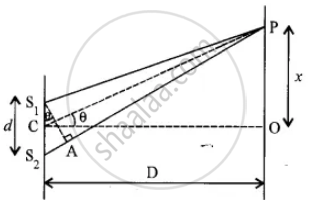
d = Distance between the slits
D = Distance between slit and screen
'P' is the position of mth order bright fringe.
From diagram, the path difference p is
S2P - S1P = S2P - AP
= S2A
`"sin"theta = ("S"_2"A")/("S"_1"S"_2)` [From Δ S1AS2]
`"tan" theta = "OP"/"CO"` [From Δ POC]
θ → 0 ∴ sin θ ≅ tan θ
∴ `("S"_2"A")/("S"_1"S"_2) = "OP"/"OC"`
`therefore ("S"_2"A")/"d" = "x"/"D"`
`therefore "S"_2"A" = "x d"/"D"`
or p = `"x" "d"/"D"`
∴ For bright fringe,
`"x d"/"D" = "m" lambda`, where m is an integer
∴ xm = `("m"lambda"D")/"d"`
∴ xm+1 = (m + 1) `(lambda"D")/"d"`
∴ Fringe width β = [(m + 1)-m] `(lambda"D")/"d"`
β = `(lambda"D")/"d"`
APPEARS IN
संबंधित प्रश्न
In Young' s experiment the ratio of intensity at the maxima and minima . in the interference pattern is 36 : 16. What is the ratio of the widths of the two slits?
Show that the fringe pattern on the screen is actually a superposition of slit diffraction from each slit.
Write three characteristic features to distinguish between the interference fringes in Young's double slit experiment and the diffraction pattern obtained due to a narrow single slit.
In Young’s double slit experiment using monochromatic light of wavelength λ, the intensity of light at a point on the screen where path difference is λ, is K units. Find out the intensity of light at a point where path difference is λ/3.
In Young's double slit experiment, derive the condition for
(i) constructive interference and
(ii) destructive interference at a point on the screen.
Find the angular separation between the consecutive bright fringes in a Young's double slit experiment with blue-green light of wavelength 500 nm. The separation between the slits is \[2 \cdot 0 \times {10}^{- 3}m.\]
White light is used in a Young's double slit experiment. Find the minimum order of the violet fringe \[\left( \lambda = 400\text{ nm} \right)\] which overlaps with a red fringe \[\left( \lambda = 700\text{ nm} \right).\]
In a Young's double slit experiment, the separation between the slits = 2.0 mm, the wavelength of the light = 600 nm and the distance of the screen from the slits = 2.0 m. If the intensity at the centre of the central maximum is 0.20 W m−2, what will be the intensity at a point 0.5 cm away from this centre along the width of the fringes?
Why does the phase difference between light from ordinary sources change randomly?
What is a fringe?
