Advertisements
Advertisements
प्रश्न
In Young's double slit experiment, derive the condition for
(i) constructive interference and
(ii) destructive interference at a point on the screen.
Advertisements
उत्तर
Young’s double slit experiment: Consider two narrow rectangular slits S1 and S2 placed perpendicular to the plane of paper. Slit S is placed on the perpendicular bisector of S1S2 and is illuminated with monochromatic light.
The slits are separated by a small distance d. A screen is placed at a distance D from S1, S2.
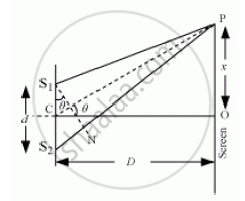
Consider a point P on the screen at distance x from O.
The path difference between the waves reaching P from S1 and S2 is:
P = S2P − S1P
Draw S1N perpendicular to S2P. Then,
P = S2P − S1P = S2P − NP = S2N
From right-angled
`DeltaS_1S^2N=(S_2N)/(S_2S_1) = sintheta`
`therefore P =S_2N=S_2S_1sintheta = d sintheta`
From ΔCOP,
When θ is small,
`sintheta≈theta≈tantheta = x/D`
`therefore P=(xd)/D`
For constructive interference,
`(xd)/D =nlambda,n=0,1,2,3,.....`
Position of nth bright fringe, `x_n = (nDlambda)/d =0,(Dlambda)/d,(2Dlambda)/d,(3Dlambda)/d,.......`
When n = 0, xn = 0, central bright fringe is formed at O.
For destructive interference,
`(xd)/D = (2n +1)lambda/2`
`or x_n = (2_n +1) (lambdaD)/(2d) = 1/2(lambdaD)/d,3/2(lambdaD)/d,5/2(lambdaD)/d,......`
Thus, alternate bright and dark fringes are formed on the screen.
संबंधित प्रश्न
In a double slit interference experiment, the separation between the slits is 1.0 mm, the wavelength of light used is 5.0 × 10⁻⁷ m and the distance of the screen from the slits is 1.0m. (a) Find the distance of the centre of the first minimum from the centre of the central maximum. (b) How many bright fringes are formed in one centimetre width on the screen?
In a Young's double slit interference experiment, the fringe pattern is observed on a screen placed at a distance D from the slits. The slits are separated by a distance d and are illuminated by monochromatic light of wavelength \[\lambda.\] Find the distance from the central point where the intensity falls to (a) half the maximum, (b) one-fourth the maximum.
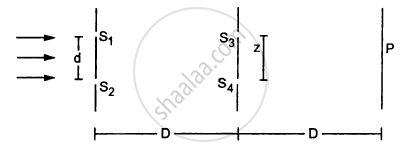
Consider the arrangement shown in the figure. By some mechanism, the separation between the slits S3 and S4 can be changed. The intensity is measured at the point P, which is at the common perpendicular bisector of S1S2 and S2S4. When \[z = \frac{D\lambda}{2d},\] the intensity measured at P is I. Find the intensity when z is equal to
(a) \[\frac{D\lambda}{d}\]
(b) \[\frac{3D\lambda}{2d}\] and
(c) \[\frac{2D\lambda}{d}\]
How is the fringe width of an interference pattern in Young's double-slit experiment affected if the two slits are brought closer to each other?
An unpolarised beam of intensity 2a2 passes through a thin polaroid. Assuming zero absorption in the polaroid, the intensity of emergent plane polarised light will be
Why is the diffraction of sound waves more evident in daily experience than that of light wave?
Consider a two-slit interference arrangement (Figure) such that the distance of the screen from the slits is half the distance between the slits. Obtain the value of D in terms of λ such that the first minima on the screen falls at a distance D from the centre O.

In a Young’s double slit experiment, the path difference at a certain point on the screen between two interfering waves is `1/8`th of the wavelength. The ratio of intensity at this point to that at the centre of a bright fringe is close to ______.
In Young's double slit experiment, show that:
`β = (λ"D")/"d"`
Where the terms have their usual meaning.
What does \(x\) denote when deriving fringe positions?
