Advertisements
Advertisements
प्रश्न
A beam of light consisting of two wavelengths, 800 nm and 600 nm is used to obtain the interference fringes in a Young's double slit experiment on a screen placed 1 · 4 m away. If the two slits are separated by 0·28 mm, calculate the least distance from the central bright maximum where the bright fringes of the two wavelengths coincide.
Advertisements
उत्तर
Given: −
λ1 = 800 nm = 800 × 10−9 m
λ2 = 600 nm = 600 × 10−9 m
D = 1.4 m
d = 0.28 mm = 0.28 × 10⁻³ m
Let n1th maximum corresponds to λ1 coincides with n2th maximum corresponds to λ2. Then,
`n_1(lambda_1D)/d =n_2 ((lambda_2)D)/d`
`or,n_1/n^2 =lambda^2/lambda^1 = 600/800 =3/4`
The minimum integral value of n1 is 3 and of n2 is 4. Therefore, the minimum value of y is,
`y_(min) = n_1(lambda_1D)/d=(3 xx 800 xx 10^-9 xx 1.4)/((0.28) xx 10^-3)`
`y_(min) =12mm`
संबंधित प्रश्न
In young’s double slit experiment, deduce the conditions for obtaining constructive and destructive interference fringes. Hence, deduce the expression for the fringe width.
The ratio of the intensities at minima to the maxima in the Young's double slit experiment is 9 : 25. Find the ratio of the widths of the two slits.
In Young's double slit experiment, derive the condition for
(i) constructive interference and
(ii) destructive interference at a point on the screen.
Find the angular separation between the consecutive bright fringes in a Young's double slit experiment with blue-green light of wavelength 500 nm. The separation between the slits is \[2 \cdot 0 \times {10}^{- 3}m.\]
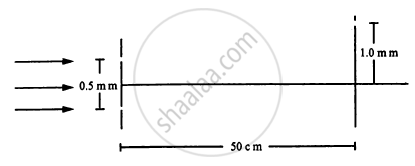
White coherent light (400 nm-700 nm) is sent through the slits of a Young's double slit experiment (see the following figure). The separation between the slits is 0⋅5 mm and the screen is 50 cm away from the slits. There is a hole in the screen at a point 1⋅0 mm away (along the width of the fringes) from the central line. (a) Which wavelength(s) will be absent in the light coming from the hole? (b) Which wavelength(s) will have a strong intensity?
In Young’s double-slit experiment, using monochromatic light, fringes are obtained on a screen placed at some distance from the slits. If the screen is moved by 5 x 10⁻² m towards the slits, the change in the fringe width is 3 x 10⁻⁵ m. If the distance between the two slits is 10-3 m, calculate the wavelength of the light used.
A thin circular ring of mass M and radius R is rotating about its axis with a constant angular velocity ω. Two objects each of mass m are attached gently to the opposite ends of diameter of the ring. The ring will now rotate with an angular velocity:
A fringe width of 6 mm was produced for two slits separated by 1 mm apart. The screen is placed 10 m away. The wavelength of light used is 'x' nm. The value of 'x' to the nearest integer is ______.
What is fringe width?
What does \(x\) denote when deriving fringe positions?
