Advertisements
Advertisements
प्रश्न
In Young's double slit experiment, derive the condition for
(i) constructive interference and
(ii) destructive interference at a point on the screen.
Advertisements
उत्तर
Young’s double slit experiment: Consider two narrow rectangular slits S1 and S2 placed perpendicular to the plane of paper. Slit S is placed on the perpendicular bisector of S1S2 and is illuminated with monochromatic light.
The slits are separated by a small distance d. A screen is placed at a distance D from S1, S2.
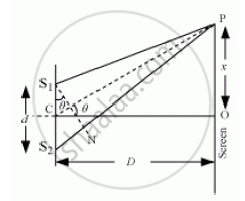
Consider a point P on the screen at distance x from O.
The path difference between the waves reaching P from S1 and S2 is:
P = S2P − S1P
Draw S1N perpendicular to S2P. Then,
P = S2P − S1P = S2P − NP = S2N
From right-angled
`DeltaS_1S^2N=(S_2N)/(S_2S_1) = sintheta`
`therefore P =S_2N=S_2S_1sintheta = d sintheta`
From ΔCOP,
When θ is small,
`sintheta≈theta≈tantheta = x/D`
`therefore P=(xd)/D`
For constructive interference,
`(xd)/D =nlambda,n=0,1,2,3,.....`
Position of nth bright fringe, `x_n = (nDlambda)/d =0,(Dlambda)/d,(2Dlambda)/d,(3Dlambda)/d,.......`
When n = 0, xn = 0, central bright fringe is formed at O.
For destructive interference,
`(xd)/D = (2n +1)lambda/2`
`or x_n = (2_n +1) (lambdaD)/(2d) = 1/2(lambdaD)/d,3/2(lambdaD)/d,5/2(lambdaD)/d,......`
Thus, alternate bright and dark fringes are formed on the screen.
संबंधित प्रश्न
A beam of light consisting of two wavelengths, 650 nm and 520 nm, is used to obtain interference fringes in a Young’s double-slit experiment.
What is the least distance from the central maximum where the bright fringes due to both the wavelengths coincide?
In Young’s double slit experiment, show graphically how the intensity of light varies with distance
Can we perform Young's double slit experiment with sound waves? To get a reasonable "fringe pattern", what should be the order of separation between the slits? How can the bright fringes and the dark fringes be detected in this case?
Draw a neat labelled diagram of Young’s Double Slit experiment. Show that `beta = (lambdaD)/d` , where the terms have their usual meanings (either for bright or dark fringe).
In Young’s double-slit experiment, using monochromatic light, fringes are obtained on a screen placed at some distance from the slits. If the screen is moved by 5 x 10⁻² m towards the slits, the change in the fringe width is 3 x 10⁻⁵ m. If the distance between the two slits is 10-3 m, calculate the wavelength of the light used.
In Young’s double slit experiment, what is the effect on fringe pattern if the slits are brought closer to each other?
"If the slits in Young's double slit experiment are identical, then intensity at any point on the screen may vary between zero and four times to the intensity due to single slit".
Justify the above statement through a relevant mathematical expression.
A projectile can have the same range R for two angles of projection. If t1 and t2 be the times of flight in two cases, then what is the product of two times of flight?
A fringe width of 6 mm was produced for two slits separated by 1 mm apart. The screen is placed 10 m away. The wavelength of light used is 'x' nm. The value of 'x' to the nearest integer is ______.
In Young's double slit experiment the two slits are 0.6 mm distance apart. Interference pattern is observed on a screen at a distance 80 cm from the slits. The first dark fringe is observed on the screen directly opposite to one of the slits. The wavelength of light will be ______ nm.
