Advertisements
Advertisements
प्रश्न
In a Young's double slit experiment, the separation between the slits = 2.0 mm, the wavelength of the light = 600 nm and the distance of the screen from the slits = 2.0 m. If the intensity at the centre of the central maximum is 0.20 W m−2, what will be the intensity at a point 0.5 cm away from this centre along the width of the fringes?
Advertisements
उत्तर
Given:-
Separation between the slits,
\[d = 2 mm = 2 \times {10}^{- 3} m\]
Wavelength of the light,
\[\lambda = 600 nm = 6 \times {10}^{-7} m\]
Distance of the screen from the slits, D = 2.0 m
\[I_\max = 0 . 20 W/ m^2 \]
For the point at a position \[y = 0 . 5 cm = 0 . 5 \times {10}^{- 2} m, \]
path difference, \[∆ x = \frac{yd}{D}.\]
\[ \Rightarrow ∆ x = \frac{0 . 5 \times {10}^{- 2} \times 2 \times {10}^{- 3}}{2}\]
\[ = 5 \times {10}^{- 6} m\]
So, the corresponding phase difference is given by
\[∆ \phi = \frac{2\pi ∆ x}{\lambda} = \frac{2\pi \times 5 \times {10}^{- 6}}{6 \times {10}^{- 7}}\]
\[ = \frac{50\pi}{3} = 16\pi + \frac{2\pi}{3}\]
or \[∆ \phi = \frac{2\pi}{3}\]
So, the amplitude of the resulting wave at point y = 0.5 cm is given by
\[A = \sqrt{a^2 + a^2 + 2 a^2 \cos \left( \frac{2\pi}{3} \right)}\]
\[ = \sqrt{a^2 + a^2 - a^2} = a \]
Similarly, the amplitude of the resulting wave at the centre is 2a.
Let the intensity of the resulting wave at point y = 0.5 cm be I.
Since \[\frac{I}{I_\max} = \frac{A^2}{\left( 2a \right)^2},\] we have
\[\frac{I}{0 . 2} = \frac{A^2}{4 a^2} = \frac{a^2}{4 a^2}\]
\[ \Rightarrow I = \frac{0 . 2}{4} = 0 . 05 W/ m^2\]
Thus, the intensity at a point 0.5 cm away from the centre along the width of the fringes is 0.05 W/m2.
APPEARS IN
संबंधित प्रश्न
Derive an expression for path difference in Young’s double slit experiment and obtain the conditions for constructive and destructive interference at a point on the screen.
The intensity at the central maxima in Young’s double slit experiment is I0. Find out the intensity at a point where the path difference is` lambda/6,lambda/4 and lambda/3.`
What is the effect on the fringe width if the distance between the slits is reduced keeping other parameters same?
A beam of light consisting of two wavelengths, 650 nm and 520 nm, is used to obtain interference fringes in a Young’s double-slit experiment.
Find the distance of the third bright fringe on the screen from the central maximum for wavelength 650 nm.
The intensity at the central maxima in Young’s double slit experimental set-up is I0. Show that the intensity at a point where the path difference is λ/3 is I0/4.
How does the fringe width get affected, if the entire experimental apparatus of Young is immersed in water?
If the separation between the slits in a Young's double slit experiment is increased, what happens to the fringe-width? If the separation is increased too much, will the fringe pattern remain detectable?
If Young's double slit experiment is performed in water, _________________ .
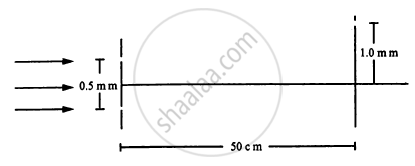
White coherent light (400 nm-700 nm) is sent through the slits of a Young's double slit experiment (see the following figure). The separation between the slits is 0⋅5 mm and the screen is 50 cm away from the slits. There is a hole in the screen at a point 1⋅0 mm away (along the width of the fringes) from the central line. (a) Which wavelength(s) will be absent in the light coming from the hole? (b) Which wavelength(s) will have a strong intensity?
In a Young's double slit interference experiment, the fringe pattern is observed on a screen placed at a distance D from the slits. The slits are separated by a distance d and are illuminated by monochromatic light of wavelength \[\lambda.\] Find the distance from the central point where the intensity falls to (a) half the maximum, (b) one-fourth the maximum.
Draw a neat labelled diagram of Young’s Double Slit experiment. Show that `beta = (lambdaD)/d` , where the terms have their usual meanings (either for bright or dark fringe).
In Young's double slit experiment using monochromatic light of wavelength 600 nm, 5th bright fringe is at a distance of 0·48 mm from the centre of the pattern. If the screen is at a distance of 80 cm from the plane of the two slits, calculate:
(i) Distance between the two slits.
(ii) Fringe width, i.e. fringe separation.
A projectile can have the same range R for two angles of projection. If t1 and t2 be the times of flight in two cases, then what is the product of two times of flight?
The Young's double slit experiment is performed with blue and with green light of wavelengths 4360Å and 5460Å respectively. If x is the distance of 4th maxima from the central one, then:
In a Young’s double slit experiment, the source is white light. One of the holes is covered by a red filter and another by a blue filter. In this case ______.
Using Young’s double slit experiment, a monochromatic light of wavelength 5000Å produces fringes of fringe width 0.5 mm. If another monochromatic light of wavelength 6000Å is used and the separation between the slits is doubled, then the new fringe width will be ______.
Interference fringes are observed on a screen by illuminating two thin slits 1 mm apart with a light source (λ = 632.8 nm). The distance between the screen and the slits is 100 cm. If a bright fringe is observed on a screen at distance of 1.27 mm from the central bright fringe, then the path difference between the waves, which are reaching this point from the slits is close to :
Monochromatic green light of wavelength 5 × 10⁻⁷ m illuminates a pair of slits 1 mm apart. The separation of bright lines in the interference pattern formed on a screen 2 m away is ______.
In an interference experiment, a third bright fringe is obtained at a point on the screen with a light of 700 nm. What should be the wavelength of the light source in order to obtain the fifth bright fringe at the same point?
What does \(d\) denote in Young's double-slit experiment?
