Advertisements
Advertisements
प्रश्न
Write three characteristic features to distinguish between the interference fringes in Young's double slit experiment and the diffraction pattern obtained due to a narrow single slit.
Advertisements
उत्तर
1. Interference is the result of interaction of light coming from two different wavefronts originating from two coherent sources,whereas diffraction pattern is the result of interaction of light coming from different parts of the same wavefront.
2. In Interference, the fringes may or may not be of the same width; while in diffraction, the fringes are always of varying widths.
3. In Interference, the bright fringes are of the same intensity; while in diffraction, the bright fringes are of varying intensities.
संबंधित प्रश्न
A beam of light consisting of two wavelengths, 650 nm and 520 nm, is used to obtain interference fringes in a Young’s double-slit experiment.
Find the distance of the third bright fringe on the screen from the central maximum for wavelength 650 nm.
A beam of light consisting of two wavelengths, 650 nm and 520 nm, is used to obtain interference fringes in a Young’s double-slit experiment.
What is the least distance from the central maximum where the bright fringes due to both the wavelengths coincide?
If the source of light used in a Young's double slit experiment is changed from red to violet, ___________ .
A Young's double slit apparatus has slits separated by 0⋅28 mm and a screen 48 cm away from the slits. The whole apparatus is immersed in water and the slits are illuminated by red light \[\left( \lambda = 700\text{ nm in vacuum} \right).\] Find the fringe-width of the pattern formed on the screen.
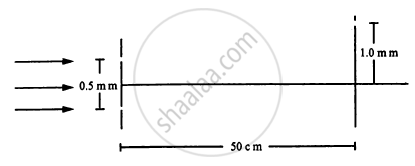
White coherent light (400 nm-700 nm) is sent through the slits of a Young's double slit experiment (see the following figure). The separation between the slits is 0⋅5 mm and the screen is 50 cm away from the slits. There is a hole in the screen at a point 1⋅0 mm away (along the width of the fringes) from the central line. (a) Which wavelength(s) will be absent in the light coming from the hole? (b) Which wavelength(s) will have a strong intensity?
In Young's double slit experiment using monochromatic light of wavelength 600 nm, 5th bright fringe is at a distance of 0·48 mm from the centre of the pattern. If the screen is at a distance of 80 cm from the plane of the two slits, calculate:
(i) Distance between the two slits.
(ii) Fringe width, i.e. fringe separation.
Write the conditions on path difference under which constructive interference occurs in Young’s double-slit experiment.
Why does the phase difference between light from ordinary sources change randomly?
What is a fringe?
What happens to fringe width when the screen distance increases while wavelength and slit separation remain unchanged?
