Advertisements
Advertisements
प्रश्न
A compound microscope has an objective of focal length 1.25 cm and eyepiece of focal length 5 cm. A small object is kept at 2.5 cm from the objective. If the final image formed is at infinity, find the distance between the objective and the eyepiece ?
Advertisements
उत्तर
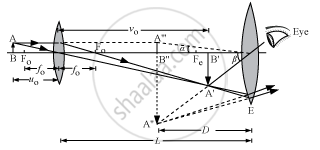
Distance between the objective and the eyepiece, L =
\[u_0 = - 2 . 5 \text {cm and } f_0 = 1 . 25 cm\]
\[\text { Now }, - \frac{1}{u_0} + \frac{1}{v_0} = \frac{1}{f_0}\] \[or \ v_0 = 2 . 5 cm\]
To find ue, we have:
\[v_e = \infty\text { and } f_e = 5 cm\]
Calculating using the same formula as above, we get:
संबंधित प्रश्न
A giant refracting telescope has an objective lens of focal length 15 m. If an eye piece of focal length 1.0 cm is used, what is the angular magnification of the telescope ?
If this telescope is used to view the moon, what is the diameter of the image of the moon formed by the objective lens ? the diameter of the moon is 3.48 × 10⁶ m and the radius of lunar orbit is 3.8 × 10⁸m.
Why must both the objective and the eyepiece of a compound microscope have short focal lengths?
A man is looking at a small object placed at his near point. Without altering the position of his eye or the object, he puts a simple microscope of magnifying power 5 X before his eyes. The angular magnification achieved is
An object is to be seen through a simple microscope of focal length 12 cm. Where should the object be placed so as to produce maximum angular magnification? The least distance for clear vision is 25 cm.
A simple microscope using a single lens often shows coloured image of a white source. Why?
Draw a labelled ray diagram showing the formation of image by a compound microscope in normal adjustment. Derive the expression for its magnifying power.
How does the resolving power of a microscope change when
(i) the diameter of the objective lens is decreased?
(ii) the wavelength of the incident light is increased ?
Justify your answer in each case.
| A compound microscope consists of two converging lenses. One of them, of smaller aperture and smaller focal length, is called objective and the other of slightly larger aperture and slightly larger focal length is called eye-piece. Both lenses are fitted in a tube with an arrangement to vary the distance between them. A tiny object is placed in front of the objective at a distance slightly greater than its focal length. The objective produces the image of the object which acts as an object for the eye-piece. The eye-piece, in turn, produces the final magnified image. |
A compound microscope consists of an objective of 10X and an eye-piece of 20X. The magnification due to the microscope would be:
In a compound microscope an object is placed at a distance of 1.5 cm from the objective of focal length 1.25 cm. If the eye-piece has a focal length of 5 cm and the final image is formed at the near point, find the magnifying power of the microscope.
