Advertisements
Advertisements
प्रश्न
Draw a labelled ray diagram of an astronomical telescope to show the image formation of a distant object. Write the main considerations required in selecting the objective and eyepiece lenses in order to have large magnifying power and high resolution of the telescope.
Advertisements
उत्तर
Astronomical telescope
When the final image is formed at the least distance of distinct vision:
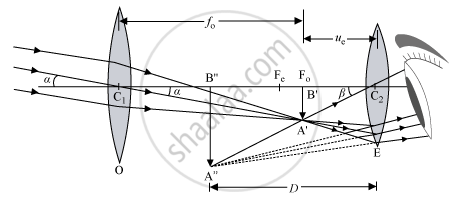
Magnifying power, `M =β/α`
Since α and β are small, we have:
∴ `M= tanβ/tanα ...... (1)`
In `ΔA'B'C_2, tanβ = (A'B')/(C_2B') `
In `ΔA'B'C_1, tanβ = (A'B')/(C_2B') `
From equation (i), we get:
`M = (A'B')/(C_2B') xx (C_1B')/(A'B')`
\[\Rightarrow\] `M = (C_1B')/(C_2B')`
Here, `C_1B' = +f_0`
\[\Rightarrow\] `C_2B' = -u_e`
\[\Rightarrow\] `M = f_0/ -u_e .......... (2)`
Using the lens equation `(1/v-1/u=1/f)`for the eyepieces `(1/-D-1/-u_e=1/f_e,)`we get:
`(-1/D+1/u_e=1/f_e)`
\[\Rightarrow\] `(1/u_e=1/(f_e)+1/D)`
\[\Rightarrow\] `(f_0)/u_e =(f_0)/(f_e )(1+f_e/D)`
\[\Rightarrow\] `(-f_0)/u_e =(-f_0)/(f_e )(1+f_e/D) or M = -f_0/(f_e) (1+f_e/D) `
In order to have a large magnifying power and high resolution of the telescope, its objective lens should have a large focal length and the eyepiece lens should have a short focal length.
संबंधित प्रश्न
Draw a ray diagram depicting the formation of the image by an astronomical telescope in normal adjustment.
An astronomical telescope is to be designed to have a magnifying power of 50 in normal adjustment. If the length of the tube is 102 cm, find the powers of the objective and the eyepiece.
(i) What is meant by resolving power of a telescope?
(ii) State any one method of increasing the resolving power of an astronomical telescope.
Read the following paragraph and answer the questions.
| A number of optical devices and instruments have been designed and developed such as periscope, binoculars, microscopes and telescopes utilising the reflecting and refracting properties of mirrors, lenses and prisms. Most of them are in common use. Our knowledge about the formation of images by the mirrors and lenses is the basic requirement for understanding the working of these devices. |
- Why the image formed at infinity is often considered most suitable for viewing. Explain
- In modern microscopes, multicomponent lenses are used for both the objective and the eyepiece. Why?
- Write two points of difference between a compound microscope and an astronomical telescope
OR
Write two distinct advantages of a reflecting type telescope over a refracting type telescope.
The magnifying power of an astronomical telescope in normal adjustment is 2.9 and the objective and the eyepiece are separated by a distance of 150 cm. Find the focal lengths of the two lenses.
Read the passage given below and answer the question that follows.
| There are two types of optical instruments: Microscopes and Telescopes. Microscopes are used to magnify very tiny objects whereas telescopes are used to study distant objects. Both of them deploy convex lenses. In his telescope, Newton used a large parabolic mirror to collect light from the stars and reduce aberrations. |
- Rohit observed the launch of Chandrayan 3 with the help of an optical instrument. Name the instrument used by him.
- State any one advantage of a reflecting telescope over a refracting telescope.
- Which instrument is used to study the structure of a virus?
- What is the ability of an optical instrument to form enlarged images called?
-
What is the difference between a compound microscope and an astronomical telescope (refracting type), as far as their lenses are concerned?
Useful Constants & Relations:
| 1 | Charge of a proton | e | 1.6 × 10⁻¹⁹ C |
| 2 | Speed of light in vacuum | c | 3 × 10⁸ ms-1 |
| 1 u = 931 MeV | |||
A telescope in which the eye lens used is concave, so that the final image is erect, is popularly called a:
Which type of telescope uses a convex lens as the eyepiece, since there is no necessity for an erect image?
In an astronomical refracting telescope, the final image formed by the eyepiece is:
Which type of telescope uses a converging lens as eyepiece and gives an inverted image?
