Advertisements
Advertisements
Question
A compound microscope has an objective of focal length 1.25 cm and eyepiece of focal length 5 cm. A small object is kept at 2.5 cm from the objective. If the final image formed is at infinity, find the distance between the objective and the eyepiece ?
Advertisements
Solution
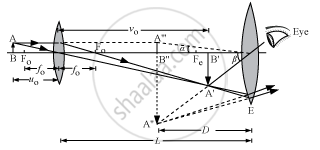
Distance between the objective and the eyepiece, L =
\[u_0 = - 2 . 5 \text {cm and } f_0 = 1 . 25 cm\]
\[\text { Now }, - \frac{1}{u_0} + \frac{1}{v_0} = \frac{1}{f_0}\] \[or \ v_0 = 2 . 5 cm\]
To find ue, we have:
\[v_e = \infty\text { and } f_e = 5 cm\]
Calculating using the same formula as above, we get:
RELATED QUESTIONS
Explain the basic differences between the construction and working of a telescope and a microscope
If this telescope is used to view the moon, what is the diameter of the image of the moon formed by the objective lens ? the diameter of the moon is 3.48 × 10⁶ m and the radius of lunar orbit is 3.8 × 10⁸m.
When viewing through a compound microscope, our eyes should be positioned not on the eyepiece but a short distance away from it for best viewing. Why? How much should be that short distance between the eye and eyepiece?
An angular magnification (magnifying power) of 30X is desired using an objective of focal length 1.25 cm and an eyepiece of focal length 5 cm. How will you set up the compound microscope?
Distinguish between myopia and hypermetropia. Show diagrammatically how these defects can be corrected.
Draw a ray diagram to show the working of a compound microscope. Deduce an expression for the total magnification when the final image is formed at the near point.
In a compound microscope, an object is placed at a distance of 1.5 cm from the objective of focal length 1.25 cm. If the eye piece has a focal length of 5 cm and the final image is formed at the near point, estimate the magnifying power of the microscope.
A man is looking at a small object placed at his near point. Without altering the position of his eye or the object, he puts a simple microscope of magnifying power 5 X before his eyes. The angular magnification achieved is
Draw a neat labelled ray diagram showing the formation of an image at the least distance of distinct vision D by a simple microscope. When the final image is at D, derive an expression for its magnifying power at D.
A microscope is focussed on a mark on a piece of paper and then a slab of glass of thickness 3 cm and refractive index 1.5 is placed over the mark. How should the microscope be moved to get the mark in focus again?
The focal lengths of the objective and the eye-piece of a compound microscope are 1.0 cm and 2.5 cm respectively. Find the tube length of the microscope for obtaining a magnification of 300.
