Advertisements
Advertisements
प्रश्न
A compound microscope has an objective of focal length 1.25 cm and eyepiece of focal length 5 cm. A small object is kept at 2.5 cm from the objective. If the final image formed is at infinity, find the distance between the objective and the eyepiece ?
Advertisements
उत्तर
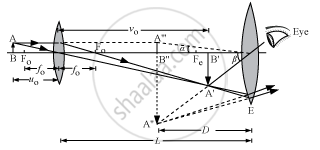
Distance between the objective and the eyepiece, L =
\[u_0 = - 2 . 5 \text {cm and } f_0 = 1 . 25 cm\]
\[\text { Now }, - \frac{1}{u_0} + \frac{1}{v_0} = \frac{1}{f_0}\] \[or \ v_0 = 2 . 5 cm\]
To find ue, we have:
\[v_e = \infty\text { and } f_e = 5 cm\]
Calculating using the same formula as above, we get:
संबंधित प्रश्न
A giant refracting telescope has an objective lens of focal length 15 m. If an eye piece of focal length 1.0 cm is used, what is the angular magnification of the telescope ?
A person with a normal near point (25 cm) using a compound microscope with the objective of focal length 8.0 mm and an eyepiece of focal length 2.5 cm can bring an object placed at 9.0 mm from the objective in sharp focus. What is the separation between the two lenses? Calculate the magnifying power of the microscope.
An angular magnification (magnifying power) of 30X is desired using an objective of focal length 1.25 cm and an eyepiece of focal length 5 cm. How will you set up the compound microscope?
Define resolving power of a microscope and write one factor on which it depends
Draw the labelled ray diagram for the formation of image by a compound microscope.
Derive the expression for the total magnification of a compound microscope. Explain why both the objective and the eyepiece of a compound microscope must have short focal lengths.
An object is placed at a distance u from a simple microscope of focal length f. The angular magnification obtained depends
Draw a labelled ray diagram showing the formation of image by a compound microscope in normal adjustment. Derive the expression for its magnifying power.
A microscope is focussed on a mark on a piece of paper and then a slab of glass of thickness 3 cm and refractive index 1.5 is placed over the mark. How should the microscope be moved to get the mark in focus again?
In the case of a regular prism, in minimum deviation position, the angle made by the refracted ray (inside the prism) with the normal drawn to the refracting surface is ______.
What is meant by a microscope in normal use?
