Advertisements
Advertisements
प्रश्न
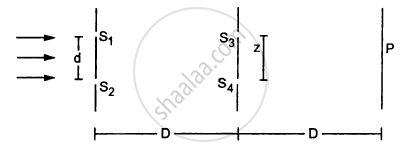
Consider the arrangement shown in the figure. By some mechanism, the separation between the slits S3 and S4 can be changed. The intensity is measured at the point P, which is at the common perpendicular bisector of S1S2 and S2S4. When \[z = \frac{D\lambda}{2d},\] the intensity measured at P is I. Find the intensity when z is equal to
(a) \[\frac{D\lambda}{d}\]
(b) \[\frac{3D\lambda}{2d}\] and
(c) \[\frac{2D\lambda}{d}\]
Advertisements
उत्तर
Given:-
Fours slits S1, S2, S3 and S4.
The separation between slits S3 and S4 can be changed.
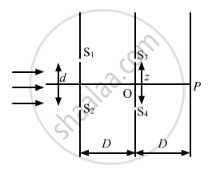
Point P is the common perpendicular bisector of S1S2 and S3S4.
(a) For \[z = \frac{\lambda D}{d}\]
The position of the slits from the central point of the first screen is given by \[y = {OS}_3 = {OS}_4 = \frac{z}{2} = \frac{\lambda D}{2d}\]
The corresponding path difference in wave fronts reaching S3 is given by \[∆ x = \frac{yd}{D} = \frac{\lambda D}{2d} \times \frac{d}{D} = \frac{\lambda}{2}\]
Similarly at S4, path difference, \[∆ x = \frac{yd}{D} = \frac{\lambda D}{2d} \times \frac{d}{D} = \frac{\lambda}{2}\]
i.e. dark fringes are formed at S3 and S4.
So, the intensity of light at S3 and S4 is zero. Hence, the intensity at P is also zero.
(b) For \[z = \frac{3\lambda D}{2d}\]
The position of the slits from the central point of the first screen is given by \[y = {OS}_3 = {OS}_4 = \frac{z}{2} = \frac{3\lambda D}{4d}\]
The corresponding path difference in wave fronts reaching S3 is given by \[∆ x = \frac{yd}{D} = \frac{3\lambda D}{4d} \times \frac{d}{D} = \frac{3\lambda}{4}\]
Similarly at S4, path difference,
\[∆ x = \frac{yd}{D} = \frac{3\lambda D}{4d} \times \frac{d}{D} = \frac{3\lambda}{4}\]
Hence, the intensity at P is I.
(c) For \[z = \frac{2\lambda D}{d}\]
The position of the slits from the central point of the first screen is given by \[y = {OS}_3 = {OS}_4 = \frac{z}{2} = \frac{2\lambda D}{2d}\]
The corresponding path difference in wave fronts reaching S3 is given by \[∆ x = \frac{yd}{D} = \frac{2\lambda D}{2d} \times \frac{d}{D} = \lambda\]
Similarly at S4, path difference, \[∆ x = \frac{yd}{D} = \frac{2\lambda D}{2d} \times \frac{d}{D} = \lambda\]
Hence, the intensity at P is 2I.
APPEARS IN
संबंधित प्रश्न
In Young's double slit experiment, using monochromatic light of wavelength λ, the intensity of light at a point on the screen where path difference is λ, is K units. Find out the intensity of light at a point where path difference is `λ/3`.
In Young's double slit experiment, describe briefly how bright and dark fringes are obtained on the screen kept in front of a double slit. Hence obtain the expression for the fringe width.
The ratio of the intensities at minima to the maxima in the Young's double slit experiment is 9 : 25. Find the ratio of the widths of the two slits.
A monochromatic light of wavelength 500 nm is incident normally on a single slit of width 0.2 mm to produce a diffraction pattern. Find the angular width of the central maximum obtained on the screen.
Estimate the number of fringes obtained in Young's double slit experiment with fringe width 0.5 mm, which can be accommodated within the region of total angular spread of the central maximum due to single slit.
The intensity at the central maxima in Young’s double slit experimental set-up is I0. Show that the intensity at a point where the path difference is λ/3 is I0/4.
In Young’s experiment interference bands were produced on a screen placed at 150 cm from two slits, 0.15 mm apart and illuminated by the light of wavelength 6500 Å. Calculate the fringe width.
If the source of light used in a Young's double slit experiment is changed from red to violet, ___________ .
The separation between the consecutive dark fringes in a Young's double slit experiment is 1.0 mm. The screen is placed at a distance of 2.5m from the slits and the separation between the slits is 1.0 mm. Calculate the wavelength of light used for the experiment.
Find the angular separation between the consecutive bright fringes in a Young's double slit experiment with blue-green light of wavelength 500 nm. The separation between the slits is \[2 \cdot 0 \times {10}^{- 3}m.\]
A source emitting light of wavelengths 480 nm and 600 nm is used in a double-slit interference experiment. The separation between the slits is 0.25 mm and the interference is observed on a screen placed at 150 cm from the slits. Find the linear separation between the first maximum (next to the central maximum) corresponding to the two wavelengths.
In Young's double slit experiment the slits are 0.589 mm apart and the interference is observed on a screen placed at a distance of 100 cm from the slits. It is found that the 9th bright fringe is at a distance of 7.5 mm from the dark fringe which is second from the center of the fringe pattern. Find the wavelength of the light used.
Two slits in Young's interference experiment have width in the ratio 1 : 2. The ratio of intensity at the maxima and minima in their interference is ______.
The force required to double the length of a steel wire of area 1 cm2, if its Young's modulus Y= 2 × 10¹¹/m2 is:
Young's double slit experiment is made in a liquid. The 10th bright fringe lies in liquid where 6th dark fringe lies in vacuum. The refractive index of the liquid is approximately
Two slits, 4mm apart, are illuminated by light of wavelength 6000 A° what will be the fringe width on a screen placed 2 m from the slits?
A beam of light consisting of two wavelengths 600 nm and 500 nm is used in Young's double slit experiment. The silt separation is 1.0 mm and the screen is kept 0.60 m away from the plane of the slits. Calculate:
- the distance of the second bright fringe from the central maximum for wavelength 500 nm, and
- the least distance from the central maximum where the bright fringes due to both wavelengths coincide.
A fringe width of 6 mm was produced for two slits separated by 1 mm apart. The screen is placed 10 m away. The wavelength of light used is 'x' nm. The value of 'x' to the nearest integer is ______.
In Young's double-slit experiment, the separation between the two slits is d and the distance of the screen from the slits is 1000 d. If the first minima fall at a distance d from the central maximum, obtain the relation between d and λ.
What does \(d\) denote in Young's double-slit experiment?
