Advertisements
Advertisements
प्रश्न
A mica strip and a polystyrene strip are fitted on the two slits of a double slit apparatus. The thickness of the strips is 0.50 mm and the separation between the slits is 0.12 cm. The refractive index of mica and polystyrene are 1.58 and 1.55, respectively, for the light of wavelength 590 nm which is used in the experiment. The interference is observed on a screen at a distance one metre away. (a) What would be the fringe-width? (b) At what distance from the centre will the first maximum be located?
Advertisements
उत्तर
Given:-
The thickness of the strips = \[t_1 = t_2 = t = 0 . 5 mm = 0 . 5 \times {10}^{- 3} m\]
Separation between the two slits,
\[d = 0 . 12 cm = 12 \times {10}^{- 4} m\]
The refractive index of mica, μm = 1.58 and of polystyrene, μp = 1.58
Wavelength of the light,
\[\lambda = 590 nm = 590 \times {10}^{- 9} m,\]
Distance between screen and slit, D = 1 m
(a)
We know that fringe width is given by
\[\beta = \frac{\lambda D}{d}\]
\[\Rightarrow \beta = \frac{590 \times {10}^{- 9} \times 1}{12 \times {10}^{- 4}}\]
\[= 4 . 9 \times {10}^{- 4} m\]
(b) When both the mica and polystyrene strips are fitted before the slits, the optical path changes by
\[∆ x = \left( \mu_m - 1 \right) t - \left( \mu_p - 1 \right) t\]
\[= \left( \mu_m - \mu_p \right) t\]
\[ = \left( 1 . 58 - 1 . 55 \right) \times \left( 0 . 5 \right) \left( {10}^{- 3} \right)\]
\[ = \left( 0 . 015 \right) \times {10}^{- 3} m\]
∴ Number of fringes shifted, n = \[\frac{∆ x}{\lambda}\]
\[\Rightarrow n = \frac{0 . 015 \times {10}^{- 3}}{590 \times {10}^{- 9}} = 25 . 43\]
∴ 25 fringes and 0.43th of a fringe.
⇒ In which 13 bright fringes and 12 dark fringes and 0.43th of a dark fringe.
So, position of first maximum on both sides is given by
On one side,
\[x = \left( 0 . 43 \right) \times 4 . 91 \times {10}^{- 4}...........\left( \because \beta = 4 . 91 \times {10}^{- 4} m \right)\]
\[= 0 . 021 cm\]
On the other side,
\[x' = \left( 1 - 0 . 43 \right) \times 4 . 91 \times {10}^{- 4} \]
\[ = 0 . 028 cm\]
APPEARS IN
संबंधित प्रश्न
In a double-slit experiment using the light of wavelength 600 nm, the angular width of the fringe formed on a distant screen is 0.1°. Find the spacing between the two slits.
In Young's double slit experiment, using monochromatic light of wavelength λ, the intensity of light at a point on the screen where path difference is λ, is K units. Find out the intensity of light at a point where path difference is `λ/3`.
In a Young’s double-slit experiment, the slits are separated by 0.28 mm and the screen is placed 1.4 m away. The distance between the central bright fringe and the fourth bright fringe is measured to be 1.2 cm. Determine the wavelength of light used in the experiment.
In a double-slit experiment the angular width of a fringe is found to be 0.2° on a screen placed 1 m away. The wavelength of light used is 600 nm. What will be the angular width of the fringe if the entire experimental apparatus is immersed in water? Take refractive index of water to be 4/3.
In Young’s experiment, the ratio of intensity at the maxima and minima in an interference
pattern is 36 : 9. What will be the ratio of the intensities of two interfering waves?
In Young’s double slit experiment, show graphically how the intensity of light varies with distance
Find the intensity at a point on a screen in Young's double slit experiment where the interfering waves have a path difference of (i) λ/6, and (ii) λ/2.
How does an unpolarized light incident on a polaroid get polarized? Describe briefly, with the help of a necessary diagram, the polarization of light by reflection from a transparent medium.
Two polaroids ‘A’ and ‘B’ are kept in crossed position. How should a third polaroid ‘C’ be placed between them so that the intensity of polarized light transmitted by polaroid B reduces to 1/8th of the intensity of unpolarized light incident on A?
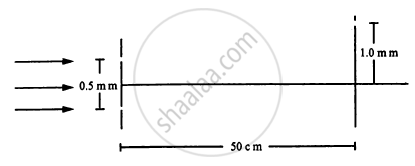
White coherent light (400 nm-700 nm) is sent through the slits of a Young's double slit experiment (see the following figure). The separation between the slits is 0⋅5 mm and the screen is 50 cm away from the slits. There is a hole in the screen at a point 1⋅0 mm away (along the width of the fringes) from the central line. (a) Which wavelength(s) will be absent in the light coming from the hole? (b) Which wavelength(s) will have a strong intensity?
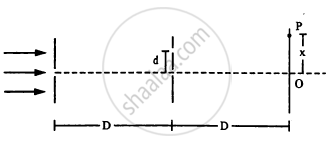
Consider the arrangement shown in the figure. The distance D is large compared to the separation d between the slits.
- Find the minimum value of d so that there is a dark fringe at O.
- Suppose d has this value. Find the distance x at which the next bright fringe is formed.
- Find the fringe-width.
In a Young's double slit experiment, the separation between the slits = 2.0 mm, the wavelength of the light = 600 nm and the distance of the screen from the slits = 2.0 m. If the intensity at the centre of the central maximum is 0.20 W m−2, what will be the intensity at a point 0.5 cm away from this centre along the width of the fringes?
What should be the path difference between two waves reaching a point for obtaining constructive interference in Young’s Double Slit experiment ?
"If the slits in Young's double slit experiment are identical, then intensity at any point on the screen may vary between zero and four times to the intensity due to single slit".
Justify the above statement through a relevant mathematical expression.
Draw the intensity distribution as function of phase angle when diffraction of light takes place through coherently illuminated single slit.
Two beams of light having intensities I and 41 interfere to produce a fringe pattern on a screen. The phase difference between the two beams are π/2 and π/3 at points A and B respectively. The difference between the resultant intensities at the two points is xl. The value of x will be ______.
In Young's double-slit experiment, the separation between the two slits is d and the distance of the screen from the slits is 1000 d. If the first minima fall at a distance d from the central maximum, obtain the relation between d and λ.
What does \(d\) denote in Young's double-slit experiment?
What happens to fringe width when the screen distance increases while wavelength and slit separation remain unchanged?
