Advertisements
Advertisements
प्रश्न
Show that the angular width of the first diffraction fringe is half that of the central fringe.
Advertisements
उत्तर
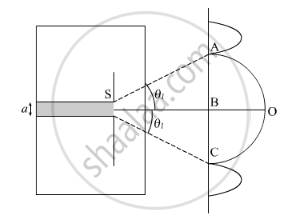
Let λ and a be the wavelength and slit width of diffracting system, respectively. Let O be the position of central maximum. Condition for the first minimum is given by
asinθ=mλ .....(1)
Let θ be the angle of diffraction.
As diffraction angle is small
∴ sinθ ≈ θ
For the first diffraction minimum, let θ = θ1
For the first minimum, take m =1
aθ1=λ
`=>theta_1=lambda/a`
Now, angular width AB = θ1
Angular width BC = θ1
Angular width AC = 2θ1
Width of central maximum = 2θ1
APPEARS IN
संबंधित प्रश्न
The fringes produced in diffraction pattern are of _______.
(A) equal width with same intensity
(B) unequal width with varying intensity
(C) equal intensity\
(D) equal width with varying intensity
In Young’s double slit experiment, show graphically how the intensity of light varies with distance
In Young’s experiment interference bands were produced on a screen placed at 150 cm from two slits, 0.15 mm apart and illuminated by the light of wavelength 6500 Å. Calculate the fringe width.
Suppose white light falls on a double slit but one slit is covered by a violet filter (allowing λ = 400 nm). Describe the nature of the fringe pattern observed.
The slits in a Young's double slit experiment have equal width and the source is placed symmetrically with respect to the slits. The intensity at the central fringe is I0. If one of the slits is closed, the intensity at this point will be ____________ .
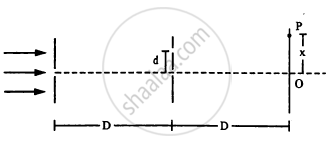
Consider the arrangement shown in the figure. The distance D is large compared to the separation d between the slits.
- Find the minimum value of d so that there is a dark fringe at O.
- Suppose d has this value. Find the distance x at which the next bright fringe is formed.
- Find the fringe-width.
Draw a neat labelled diagram of Young’s Double Slit experiment. Show that `beta = (lambdaD)/d` , where the terms have their usual meanings (either for bright or dark fringe).
The force required to double the length of a steel wire of area 1 cm2, if its Young's modulus Y= 2 × 10¹¹/m2 is:
In Young's double slit experiment, show that:
`β = (λ"D")/"d"`
Where the terms have their usual meaning.
What does \(d\) denote in Young's double-slit experiment?
