Advertisements
Advertisements
Question
Show that the angular width of the first diffraction fringe is half that of the central fringe.
Advertisements
Solution
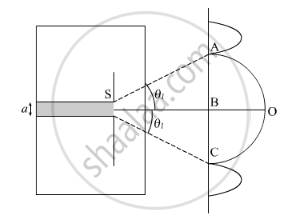
Let λ and a be the wavelength and slit width of diffracting system, respectively. Let O be the position of central maximum. Condition for the first minimum is given by
asinθ=mλ .....(1)
Let θ be the angle of diffraction.
As diffraction angle is small
∴ sinθ ≈ θ
For the first diffraction minimum, let θ = θ1
For the first minimum, take m =1
aθ1=λ
`=>theta_1=lambda/a`
Now, angular width AB = θ1
Angular width BC = θ1
Angular width AC = 2θ1
Width of central maximum = 2θ1
APPEARS IN
RELATED QUESTIONS
A beam of light consisting of two wavelengths, 650 nm and 520 nm, is used to obtain interference fringes in a Young’s double-slit experiment.
Find the distance of the third bright fringe on the screen from the central maximum for wavelength 650 nm.
In Young's double slit experiment, derive the condition for
(i) constructive interference and
(ii) destructive interference at a point on the screen.
In Young’s double slit experiment to produce interference pattern, obtain the conditions for constructive and destructive interference. Hence deduce the expression for the fringe width.
A thin paper of thickness 0.02 mm having a refractive index 1.45 is pasted across one of the slits in a Young's double slit experiment. The paper transmits 4/9 of the light energy falling on it. (a) Find the ratio of the maximum intensity to the minimum intensity in the fringe pattern. (b) How many fringes will cross through the centre if an identical paper piece is pasted on the other slit also? The wavelength of the light used is 600 nm.
In Young's double slit experiment shown in figure S1 and S2 are coherent sources and S is the screen having a hole at a point 1.0 mm away from the central line. White light (400 to 700 nm) is sent through the slits. Which wavelength passing through the hole has strong intensity?

Why is the diffraction of sound waves more evident in daily experience than that of light wave?
What is a fringe?
What is the interference pattern observed on the screen in Young's double-slit experiment?
What does \(x\) denote when deriving fringe positions?
What is the angular fringe width \(\alpha\)?
