Advertisements
Advertisements
प्रश्न
Show that the angular width of the first diffraction fringe is half that of the central fringe.
Advertisements
उत्तर
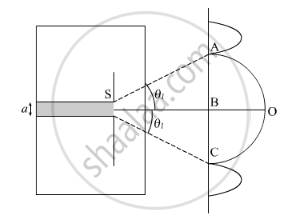
Let λ and a be the wavelength and slit width of diffracting system, respectively. Let O be the position of central maximum. Condition for the first minimum is given by
asinθ=mλ .....(1)
Let θ be the angle of diffraction.
As diffraction angle is small
∴ sinθ ≈ θ
For the first diffraction minimum, let θ = θ1
For the first minimum, take m =1
aθ1=λ
`=>theta_1=lambda/a`
Now, angular width AB = θ1
Angular width BC = θ1
Angular width AC = 2θ1
Width of central maximum = 2θ1
APPEARS IN
संबंधित प्रश्न
If one of two identical slits producing interference in Young’s experiment is covered with glass, so that the light intensity passing through it is reduced to 50%, find the ratio of the maximum and minimum intensity of the fringe in the interference pattern.
In Young’s double slit experiment to produce interference pattern, obtain the conditions for constructive and destructive interference. Hence deduce the expression for the fringe width.
Can we perform Young's double slit experiment with sound waves? To get a reasonable "fringe pattern", what should be the order of separation between the slits? How can the bright fringes and the dark fringes be detected in this case?
How is the fringe width of an interference pattern in Young's double-slit experiment affected if the two slits are brought closer to each other?
Wavefront is ______.
The force required to double the length of a steel wire of area 1 cm2, if its Young's modulus Y= 2 × 10¹¹/m2 is:
A beam of light consisting of two wavelengths 600 nm and 500 nm is used in Young's double slit experiment. The silt separation is 1.0 mm and the screen is kept 0.60 m away from the plane of the slits. Calculate:
- the distance of the second bright fringe from the central maximum for wavelength 500 nm, and
- the least distance from the central maximum where the bright fringes due to both wavelengths coincide.
In a Young's double slit experiment, the width of the one of the slit is three times the other slit. The amplitude of the light coming from a slit is proportional to the slit- width. Find the ratio of the maximum to the minimum intensity in the interference pattern.
Monochromatic green light of wavelength 5 × 10⁻⁷ m illuminates a pair of slits 1 mm apart. The separation of bright lines in the interference pattern formed on a screen 2 m away is ______.
In an interference experiment, a third bright fringe is obtained at a point on the screen with a light of 700 nm. What should be the wavelength of the light source in order to obtain the fifth bright fringe at the same point?
