Advertisements
Advertisements
Question
In Young's double slit experiment, describe briefly how bright and dark fringes are obtained on the screen kept in front of a double slit. Hence obtain the expression for the fringe width.
Advertisements
Solution
In Young's double-slit experiment, the wavefronts from the two illuminated slits superpose on the screen. This leads to formation of alternate dark and bright fringes due to constructive and destructive interference, respectively. At the centre C of the screen, the intensity of light is maximum and it is called central maxima.
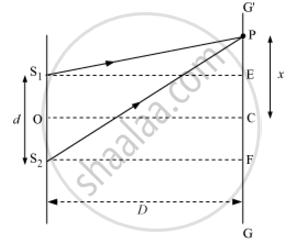
Let S1 and S2 be two slits separated by a distance d. GG'is the screen at a distance D from the slits S1 and S2. Point C is equidistant from both the slits. The intensity of light will be maximum at this point because the path difference of the waves reaching this point will be zero.
At point P, the path difference between the rays coming from the slits S1 and S2 is S2P - S1P.
Now, S1 S2 = d, EF = d, and S2F= D
∴In ΔS2PF,
`S_2P=[S_2F^2+PF^2]^(1/2)`
`S_2P=[D^2+(x+d/2)^2]^(1/2)`
`=D[1+(x+d/2)/D^2]^(1/2)`
Similarly, in ΔS1PE,
`S_1P=D[1+(x-d/2)^2/D^2]^(1/2)`
`:.S_2P-S_1P=D[1+1/2(x+d/2)^2/D^2]-D[1+1/2(x-d/2)^2/D^2]`
On expanding it binomially,
`S_2P-S_1P=1/(2D)[4xd/2]=(xd)/D`
For bright fringes (constructive interference), the path difference is an integral multiple of wavelengths, i.e. path difference is nλ.
`:.nlambda=(xd)/D`
`x=(nlambdaD)/d`where n = 0, 1, 2, 3, 4, …
For n = 0, x0 = 0
n =1, `x_1=(lambdaD)d`
n = 2, `x_2=(2lambdaD)/d`
n =3, `x_3=(3lambdaD)d`
`n=n, x_n = (nlambdaD)/d`
Fringe width (β) → Separation between the centres of two consecutive bright fringes is called the width of a dark fringe.
`:.beta_1=x_n-x_(n-1)=(lambdaD)/d`
Similarly, for dark fringes,
`x_n=(2n-1)lambda/2D/d`
For n =1, `x_1=(lambdaD)/(2d)`
For n =2, `x_2=(3lambdaD)/(2d)`
The separation between the centres of two consecutive dark interference fringes is the width of a bright fringe.
`:. beta_2=x_n-x_(n-1)=(lambdaD)/d`
∴β1 = β2
All the bright and dark fringes are of equal width as β1 = β2
APPEARS IN
RELATED QUESTIONS
A beam of light consisting of two wavelengths, 650 nm and 520 nm, is used to obtain interference fringes in a Young’s double-slit experiment.
What is the least distance from the central maximum where the bright fringes due to both the wavelengths coincide?
If one of two identical slits producing interference in Young’s experiment is covered with glass, so that the light intensity passing through it is reduced to 50%, find the ratio of the maximum and minimum intensity of the fringe in the interference pattern.
If the separation between the slits in a Young's double slit experiment is increased, what happens to the fringe-width? If the separation is increased too much, will the fringe pattern remain detectable?
In Young's double slit experiment shown in figure S1 and S2 are coherent sources and S is the screen having a hole at a point 1.0 mm away from the central line. White light (400 to 700 nm) is sent through the slits. Which wavelength passing through the hole has strong intensity?

The maximum number of possible interference maxima for slit-separation equal to twice the wavelength in Young's double-slit experiment is ______.
- Assertion (A): In Young's double slit experiment all fringes are of equal width.
- Reason (R): The fringe width depends upon the wavelength of light (λ) used, the distance of the screen from the plane of slits (D) and slits separation (d).
In Young's double-slit experiment, the screen is moved away from the plane of the slits. What will be its effect on the following?
- The angular separation of the fringes.
- Fringe-width.
If the monochromatic source in Young’s double slit experiment is replaced by white light, then ______.
What is the angular fringe width \(\alpha\)?
What happens to fringe width when the wavelength of light increases while screen distance and slit separation remain unchanged?
