Advertisements
Advertisements
प्रश्न
In Young's double slit experiment, describe briefly how bright and dark fringes are obtained on the screen kept in front of a double slit. Hence obtain the expression for the fringe width.
Advertisements
उत्तर
In Young's double-slit experiment, the wavefronts from the two illuminated slits superpose on the screen. This leads to formation of alternate dark and bright fringes due to constructive and destructive interference, respectively. At the centre C of the screen, the intensity of light is maximum and it is called central maxima.
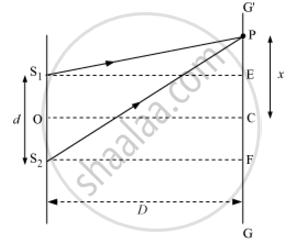
Let S1 and S2 be two slits separated by a distance d. GG'is the screen at a distance D from the slits S1 and S2. Point C is equidistant from both the slits. The intensity of light will be maximum at this point because the path difference of the waves reaching this point will be zero.
At point P, the path difference between the rays coming from the slits S1 and S2 is S2P - S1P.
Now, S1 S2 = d, EF = d, and S2F= D
∴In ΔS2PF,
`S_2P=[S_2F^2+PF^2]^(1/2)`
`S_2P=[D^2+(x+d/2)^2]^(1/2)`
`=D[1+(x+d/2)/D^2]^(1/2)`
Similarly, in ΔS1PE,
`S_1P=D[1+(x-d/2)^2/D^2]^(1/2)`
`:.S_2P-S_1P=D[1+1/2(x+d/2)^2/D^2]-D[1+1/2(x-d/2)^2/D^2]`
On expanding it binomially,
`S_2P-S_1P=1/(2D)[4xd/2]=(xd)/D`
For bright fringes (constructive interference), the path difference is an integral multiple of wavelengths, i.e. path difference is nλ.
`:.nlambda=(xd)/D`
`x=(nlambdaD)/d`where n = 0, 1, 2, 3, 4, …
For n = 0, x0 = 0
n =1, `x_1=(lambdaD)d`
n = 2, `x_2=(2lambdaD)/d`
n =3, `x_3=(3lambdaD)d`
`n=n, x_n = (nlambdaD)/d`
Fringe width (β) → Separation between the centres of two consecutive bright fringes is called the width of a dark fringe.
`:.beta_1=x_n-x_(n-1)=(lambdaD)/d`
Similarly, for dark fringes,
`x_n=(2n-1)lambda/2D/d`
For n =1, `x_1=(lambdaD)/(2d)`
For n =2, `x_2=(3lambdaD)/(2d)`
The separation between the centres of two consecutive dark interference fringes is the width of a bright fringe.
`:. beta_2=x_n-x_(n-1)=(lambdaD)/d`
∴β1 = β2
All the bright and dark fringes are of equal width as β1 = β2
APPEARS IN
संबंधित प्रश्न
In a double-slit experiment the angular width of a fringe is found to be 0.2° on a screen placed 1 m away. The wavelength of light used is 600 nm. What will be the angular width of the fringe if the entire experimental apparatus is immersed in water? Take refractive index of water to be 4/3.
In Young’s double slit experiment, show graphically how the intensity of light varies with distance
In Young’s experiment interference bands were produced on a screen placed at 150 cm from two slits, 0.15 mm apart and illuminated by the light of wavelength 6500 Å. Calculate the fringe width.
In a Young's double slit experiment, \[\lambda = 500\text{ nm, d = 1.0 mm and D = 1.0 m.}\] Find the minimum distance from the central maximum for which the intensity is half of the maximum intensity.
In Young’s double-slit experiment, using monochromatic light, fringes are obtained on a screen placed at some distance from the slits. If the screen is moved by 5 x 10⁻² m towards the slits, the change in the fringe width is 3 x 10⁻⁵ m. If the distance between the two slits is 10-3 m, calculate the wavelength of the light used.
A thin circular ring of mass M and radius R is rotating about its axis with a constant angular velocity ω. Two objects each of mass m are attached gently to the opposite ends of diameter of the ring. The ring will now rotate with an angular velocity:
In a Young's double slit experiment, the width of the one of the slit is three times the other slit. The amplitude of the light coming from a slit is proportional to the slit- width. Find the ratio of the maximum to the minimum intensity in the interference pattern.
Two beams of light having intensities I and 41 interfere to produce a fringe pattern on a screen. The phase difference between the two beams are π/2 and π/3 at points A and B respectively. The difference between the resultant intensities at the two points is xl. The value of x will be ______.
What does \(x\) denote when deriving fringe positions?
What happens to fringe width when the wavelength of light increases while screen distance and slit separation remain unchanged?
