Advertisements
Advertisements
प्रश्न
In Young's double slit experiment, describe briefly how bright and dark fringes are obtained on the screen kept in front of a double slit. Hence obtain the expression for the fringe width.
Advertisements
उत्तर
In Young's double-slit experiment, the wavefronts from the two illuminated slits superpose on the screen. This leads to formation of alternate dark and bright fringes due to constructive and destructive interference, respectively. At the centre C of the screen, the intensity of light is maximum and it is called central maxima.
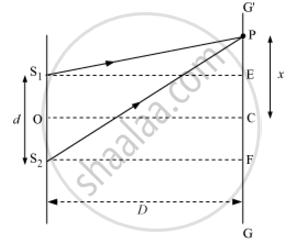
Let S1 and S2 be two slits separated by a distance d. GG'is the screen at a distance D from the slits S1 and S2. Point C is equidistant from both the slits. The intensity of light will be maximum at this point because the path difference of the waves reaching this point will be zero.
At point P, the path difference between the rays coming from the slits S1 and S2 is S2P - S1P.
Now, S1 S2 = d, EF = d, and S2F= D
∴In ΔS2PF,
`S_2P=[S_2F^2+PF^2]^(1/2)`
`S_2P=[D^2+(x+d/2)^2]^(1/2)`
`=D[1+(x+d/2)/D^2]^(1/2)`
Similarly, in ΔS1PE,
`S_1P=D[1+(x-d/2)^2/D^2]^(1/2)`
`:.S_2P-S_1P=D[1+1/2(x+d/2)^2/D^2]-D[1+1/2(x-d/2)^2/D^2]`
On expanding it binomially,
`S_2P-S_1P=1/(2D)[4xd/2]=(xd)/D`
For bright fringes (constructive interference), the path difference is an integral multiple of wavelengths, i.e. path difference is nλ.
`:.nlambda=(xd)/D`
`x=(nlambdaD)/d`where n = 0, 1, 2, 3, 4, …
For n = 0, x0 = 0
n =1, `x_1=(lambdaD)d`
n = 2, `x_2=(2lambdaD)/d`
n =3, `x_3=(3lambdaD)d`
`n=n, x_n = (nlambdaD)/d`
Fringe width (β) → Separation between the centres of two consecutive bright fringes is called the width of a dark fringe.
`:.beta_1=x_n-x_(n-1)=(lambdaD)/d`
Similarly, for dark fringes,
`x_n=(2n-1)lambda/2D/d`
For n =1, `x_1=(lambdaD)/(2d)`
For n =2, `x_2=(3lambdaD)/(2d)`
The separation between the centres of two consecutive dark interference fringes is the width of a bright fringe.
`:. beta_2=x_n-x_(n-1)=(lambdaD)/d`
∴β1 = β2
All the bright and dark fringes are of equal width as β1 = β2
APPEARS IN
संबंधित प्रश्न
The ratio of the intensities at minima to the maxima in the Young's double slit experiment is 9 : 25. Find the ratio of the widths of the two slits.
In Young’s double slit experiment using monochromatic light of wavelength λ, the intensity of light at a point on the screen where path difference is λ, is K units. Find out the intensity of light at a point where path difference is λ/3.
In a Young's double slit experiment, two narrow vertical slits placed 0.800 mm apart are illuminated by the same source of yellow light of wavelength 589 nm. How far are the adjacent bright bands in the interference pattern observed on a screen 2.00 m away?
Find the angular separation between the consecutive bright fringes in a Young's double slit experiment with blue-green light of wavelength 500 nm. The separation between the slits is \[2 \cdot 0 \times {10}^{- 3}m.\]
In Young’s double-slit experiment, using monochromatic light, fringes are obtained on a screen placed at some distance from the slits. If the screen is moved by 5 x 10⁻² m towards the slits, the change in the fringe width is 3 x 10⁻⁵ m. If the distance between the two slits is 10-3 m, calculate the wavelength of the light used.
In Young’s double-slit experiment, show that:
`beta = (lambda "D")/"d"` where the terms have their usual meaning.
In Young's double slit experiment using light of wavelength 600 nm, the slit separation is 0.8 mm and the screen is kept 1.6 m from the plane of the slits. Calculate
- the fringe width
- the distance of (a) third minimum and (b) fifth maximum, from the central maximum.
In a double-slit experiment with monochromatic light, fringes are obtained on a screen placed at some distance from the plane of slits. If the screen is moved by 5 × 10⁻² m towards the slits, the change in fringe width is 3 × 10⁻³ cm. If the distance between the slits is 1 mm, then the wavelength of the light will be ______ nm.
What is the interference pattern observed on the screen in Young's double-slit experiment?
For small angles, what is the approximate path difference at a point a distance \(x\) from the central bright fringe?
