Advertisements
Advertisements
प्रश्न
Show that the fringe pattern on the screen is actually a superposition of slit diffraction from each slit.
Advertisements
उत्तर
The intensity variation in the fringe pattern obtained on a screen in a Young’s double slit experiment corresponds to both single slit diffraction and double slit interference because the two sources are slits of finite width in the double slit experiment.
If a lens is placed in front of the double slits and when one of the slit S1 is closed and the other kept open, a single slit diffraction is formed on the screen. A similar diffraction pattern is obtained on the screen if the slit S1 is kept open and S2 is closed. Both diffraction patterns form on the same position on the screen in the focal plane of the lens. When both slits open simultaneously, the resulting total intensity pattern on the screen is actually the superposition of the single slit diffraction pattern formed by waves from various point sources of each slit and a double slit interference pattern as shown. The actual double slit intensity pattern consists of the interference pattern (solid lines) formed within the diffraction pattern (dotted lines).

APPEARS IN
संबंधित प्रश्न
Two coherent sources of light having intensity ratio 81 : 1 produce interference fringes. Calculate the ratio of intensities at the maxima and minima in the interference pattern.
If the separation between the slits in a Young's double slit experiment is increased, what happens to the fringe-width? If the separation is increased too much, will the fringe pattern remain detectable?
Consider the arrangement shown in the figure. By some mechanism, the separation between the slits S3 and S4 can be changed. The intensity is measured at the point P, which is at the common perpendicular bisector of S1S2 and S2S4. When \[z = \frac{D\lambda}{2d},\] the intensity measured at P is I. Find the intensity when z is equal to
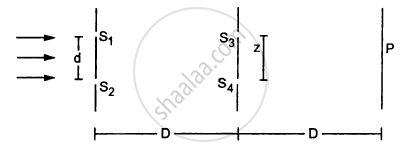
(a) \[\frac{D\lambda}{d}\]
(b) \[\frac{3D\lambda}{2d}\] and
(c) \[\frac{2D\lambda}{d}\]
Draw a neat labelled diagram of Young’s Double Slit experiment. Show that `beta = (lambdaD)/d` , where the terms have their usual meanings (either for bright or dark fringe).
Write the conditions on path difference under which constructive interference occurs in Young’s double-slit experiment.
Two balls are projected at an angle θ and (90° − θ) to the horizontal with the same speed. The ratio of their maximum vertical heights is:
Two slits, 4mm apart, are illuminated by light of wavelength 6000 A° what will be the fringe width on a screen placed 2 m from the slits?
ASSERTION (A): In an interference pattern observed in Young's double slit experiment, if the separation (d) between coherent sources as well as the distance (D) of the screen from the coherent sources both are reduced to 1/3rd, then new fringe width remains the same.
REASON (R): Fringe width is proportional to (d/D).
A beam of light consisting of two wavelengths 600 nm and 500 nm is used in Young's double slit experiment. The silt separation is 1.0 mm and the screen is kept 0.60 m away from the plane of the slits. Calculate:
- the distance of the second bright fringe from the central maximum for wavelength 500 nm, and
- the least distance from the central maximum where the bright fringes due to both wavelengths coincide.
- Assertion (A): In Young's double slit experiment all fringes are of equal width.
- Reason (R): The fringe width depends upon the wavelength of light (λ) used, the distance of the screen from the plane of slits (D) and slits separation (d).
