Advertisements
Advertisements
प्रश्न
If one of two identical slits producing interference in Young’s experiment is covered with glass, so that the light intensity passing through it is reduced to 50%, find the ratio of the maximum and minimum intensity of the fringe in the interference pattern.
Advertisements
उत्तर
We know that intensity is directly proportional to the square of an amplitude
`I prop a^2`
if `I_1 = I/2`
if intensity reduced to 50%, the amplitude will be `a/sqrta2`
then `r = sqrt2`
`I_"max"/I_"min" = (r+1)^2/(r-1)^2 = (sqrt2 + 1)^2/(sqrt2 - 1)^2`
`I_"max"/I_"min" = ((2.414)/(0.414))^2 = (5.83)^2`
`I_"max"/I_"min"` = 33.98 ≅ 34
APPEARS IN
संबंधित प्रश्न
In a Young’s double-slit experiment, the slits are separated by 0.28 mm and the screen is placed 1.4 m away. The distance between the central bright fringe and the fourth bright fringe is measured to be 1.2 cm. Determine the wavelength of light used in the experiment.
The fringes produced in diffraction pattern are of _______.
(A) equal width with same intensity
(B) unequal width with varying intensity
(C) equal intensity\
(D) equal width with varying intensity
Find the intensity at a point on a screen in Young's double slit experiment where the interfering waves have a path difference of (i) λ/6, and (ii) λ/2.
Find the angular separation between the consecutive bright fringes in a Young's double slit experiment with blue-green light of wavelength 500 nm. The separation between the slits is \[2 \cdot 0 \times {10}^{- 3}m.\]
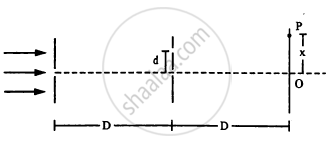
Consider the arrangement shown in the figure. The distance D is large compared to the separation d between the slits.
- Find the minimum value of d so that there is a dark fringe at O.
- Suppose d has this value. Find the distance x at which the next bright fringe is formed.
- Find the fringe-width.
In a Young’s double slit experiment, the source is white light. One of the holes is covered by a red filter and another by a blue filter. In this case ______.
How will the interference pattern in Young's double-slit experiment be affected if the screen is moved away from the plane of the slits?
In an interference experiment, a third bright fringe is obtained at a point on the screen with a light of 700 nm. What should be the wavelength of the light source in order to obtain the fifth bright fringe at the same point?
What is the consequence of random phase variation for ordinary light sources?
What is fringe width?
