Advertisements
Advertisements
प्रश्न
A mica strip and a polystyrene strip are fitted on the two slits of a double slit apparatus. The thickness of the strips is 0.50 mm and the separation between the slits is 0.12 cm. The refractive index of mica and polystyrene are 1.58 and 1.55, respectively, for the light of wavelength 590 nm which is used in the experiment. The interference is observed on a screen at a distance one metre away. (a) What would be the fringe-width? (b) At what distance from the centre will the first maximum be located?
Advertisements
उत्तर
Given:-
The thickness of the strips = \[t_1 = t_2 = t = 0 . 5 mm = 0 . 5 \times {10}^{- 3} m\]
Separation between the two slits,
\[d = 0 . 12 cm = 12 \times {10}^{- 4} m\]
The refractive index of mica, μm = 1.58 and of polystyrene, μp = 1.58
Wavelength of the light,
\[\lambda = 590 nm = 590 \times {10}^{- 9} m,\]
Distance between screen and slit, D = 1 m
(a)
We know that fringe width is given by
\[\beta = \frac{\lambda D}{d}\]
\[\Rightarrow \beta = \frac{590 \times {10}^{- 9} \times 1}{12 \times {10}^{- 4}}\]
\[= 4 . 9 \times {10}^{- 4} m\]
(b) When both the mica and polystyrene strips are fitted before the slits, the optical path changes by
\[∆ x = \left( \mu_m - 1 \right) t - \left( \mu_p - 1 \right) t\]
\[= \left( \mu_m - \mu_p \right) t\]
\[ = \left( 1 . 58 - 1 . 55 \right) \times \left( 0 . 5 \right) \left( {10}^{- 3} \right)\]
\[ = \left( 0 . 015 \right) \times {10}^{- 3} m\]
∴ Number of fringes shifted, n = \[\frac{∆ x}{\lambda}\]
\[\Rightarrow n = \frac{0 . 015 \times {10}^{- 3}}{590 \times {10}^{- 9}} = 25 . 43\]
∴ 25 fringes and 0.43th of a fringe.
⇒ In which 13 bright fringes and 12 dark fringes and 0.43th of a dark fringe.
So, position of first maximum on both sides is given by
On one side,
\[x = \left( 0 . 43 \right) \times 4 . 91 \times {10}^{- 4}...........\left( \because \beta = 4 . 91 \times {10}^{- 4} m \right)\]
\[= 0 . 021 cm\]
On the other side,
\[x' = \left( 1 - 0 . 43 \right) \times 4 . 91 \times {10}^{- 4} \]
\[ = 0 . 028 cm\]
APPEARS IN
संबंधित प्रश्न
(i) In Young's double-slit experiment, deduce the condition for (a) constructive and (b) destructive interferences at a point on the screen. Draw a graph showing variation of intensity in the interference pattern against position 'x' on the screen.
(b) Compare the interference pattern observed in Young's double-slit experiment with single-slit diffraction pattern, pointing out three distinguishing features.
A monochromatic light of wavelength 500 nm is incident normally on a single slit of width 0.2 mm to produce a diffraction pattern. Find the angular width of the central maximum obtained on the screen.
Estimate the number of fringes obtained in Young's double slit experiment with fringe width 0.5 mm, which can be accommodated within the region of total angular spread of the central maximum due to single slit.
Write two characteristics features distinguish the diffractions pattern from the interference fringes obtained in Young’s double slit experiment.
In a Young's double slit experiment, using monochromatic light, the fringe pattern shifts by a certain distance on the screen when a mica sheet of refractive index 1.6 and thickness 1.964 micron (1 micron = 10−6 m) is introduced in the path of one of the interfering waves. The mica sheet is then removed and the distance between the screen and the slits is doubled. It is found that the distance between the successive maxima now is the same as the observed fringe-shift upon the introduction of the mica sheet. Calculate the wavelength of the monochromatic light used in the experiment.
A thin paper of thickness 0.02 mm having a refractive index 1.45 is pasted across one of the slits in a Young's double slit experiment. The paper transmits 4/9 of the light energy falling on it. (a) Find the ratio of the maximum intensity to the minimum intensity in the fringe pattern. (b) How many fringes will cross through the centre if an identical paper piece is pasted on the other slit also? The wavelength of the light used is 600 nm.
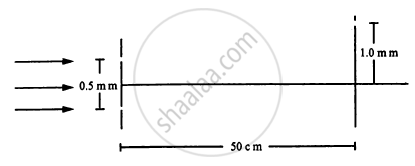
White coherent light (400 nm-700 nm) is sent through the slits of a Young's double slit experiment (see the following figure). The separation between the slits is 0⋅5 mm and the screen is 50 cm away from the slits. There is a hole in the screen at a point 1⋅0 mm away (along the width of the fringes) from the central line. (a) Which wavelength(s) will be absent in the light coming from the hole? (b) Which wavelength(s) will have a strong intensity?
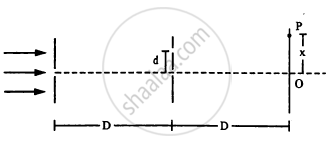
Consider the arrangement shown in the figure. The distance D is large compared to the separation d between the slits.
- Find the minimum value of d so that there is a dark fringe at O.
- Suppose d has this value. Find the distance x at which the next bright fringe is formed.
- Find the fringe-width.
How is the fringe width of an interference pattern in Young's double-slit experiment affected if the two slits are brought closer to each other?
In Young's double-slit experiment, the two slits are separated by a distance of 1.5 mm, and the screen is placed 1 m away from the plane of the slits. A beam of light consisting of two wavelengths of 650 nm and 520 nm is used to obtain interference fringes.
Find the distance of the third bright fringe for λ = 520 nm on the screen from the central maximum.
Write the conditions on path difference under which constructive interference occurs in Young’s double-slit experiment.
In Young’s double slit experiment, what should be the phase difference between the two overlapping waves to obtain 5th dark band/fringe on the screen?
An unpolarised beam of intensity 2a2 passes through a thin polaroid. Assuming zero absorption in the polaroid, the intensity of emergent plane polarised light will be
Consider a two-slit interference arrangement (Figure) such that the distance of the screen from the slits is half the distance between the slits. Obtain the value of D in terms of λ such that the first minima on the screen falls at a distance D from the centre O.

A slit of width 0.6 mm is illuminated by a beam of light consisting of two wavelengths 600 nm and 480 nm. The diffraction pattern is observed on a screen 1.0 m from the slit. Find:
- The distance of the second bright fringe from the central maximum pertaining to the light of 600 nm.
- The least distance from the central maximum at which bright fringes due to both wavelengths coincide.
Interference fringes are observed on a screen by illuminating two thin slits 1 mm apart with a light source (λ = 632.8 nm). The distance between the screen and the slits is 100 cm. If a bright fringe is observed on a screen at distance of 1.27 mm from the central bright fringe, then the path difference between the waves, which are reaching this point from the slits is close to :
What is required to obtain a clear interference pattern?
What does \(d\) denote in Young's double-slit experiment?
What does \(x\) denote when deriving fringe positions?
What does \(\lambda\) denote in the fringe-position expressions?
